


...It is a long tale...

 | |
| J.R.R. Tolkien's monogram | |
|---|---|
| Gallery | Images of J.R.R. Tolkien's monogram |
J.R.R. Tolkien's signature and monogram are synonymous with Tolkien's works, and have a history of their own. Both are registered trademarks owned by the Tolkien Estate.
Signature history
Tolkien's signature evolved over time. As early as 1910, he is recorded as having signed his name as "Ronald Tolkien" on an art piece titled Ruins at West End of White Abbey.[1] In 1913 he signed his name as the more familiar "J.R.R. Tolkien" on his painting entitled Foxglove Year[2], which accompanied a poem he wrote by the same name. A further evolution of Tolkien's signature is visible from a 1923 signing of a book he owned called The Latin Poems.[3]
-

J.R.R. Tolkien signing as "Ronald Tolkien" in 1910.
-

Tolkien's signature from his 1913 painting Foxglove Year.
-
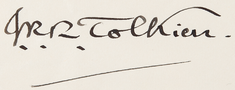
A typical example of Tolkien's more well known later signature.
-
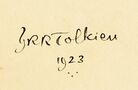
A 1923 signature from a book of Latin Poems.


.jpg)
Forgeries
Monogram history
Early monograms
Tolkien's first recorded use of a monogram was on a sketch titled Lyme Regis Harbor from the Drawing Room Window of the Cups Hotel in 1906[4] and included just a "J", an "R", and a "T". Another monogram appeared on a 1911 illustration titled Lamb's Farm, Gedling. The first use of the two-"R" motif (with one "R" being flipped) was in 1912 on a sheet containing two sketches, Keystone of Door and Gargoyles, South Side, Lambourn[5]. 1913 saw the first use of the four dot design in a monogram on a piece titled Grownupishness[6]. Another 1913 monogram contained the first instance of two uses of the four dots design on a piece titled Pagent House Gardens, Warwick[7]. In 1914, a symmetrical monogram design appeared in the first text about Middle-earth's genesis called Tanaqui,[8] which depicted an early version of the mountain Taniquetil. In 1918, a monogram closely resembling the final monogram appeared on a piece entitled Gipsy Green.[9]
-

Tolkien's first recorded monogram from 1906.
-

A 1911 Tolkien Monogram that appeared on the illustration Lamb's Farm, Gedling.
-

Tolkien's first recorded use of a two-R version of the monogram from 1912.
-

Tolkien's first use of the "four dots" in 1913.
-

Tolkien's first monogram utilizing two instances of the "four dot" motif.
-

A symmetrical Tolkien monogram from 1914.
-

A 1918 monogram from Tolkien's painting Gipsy Green.


Monogram usage in The Hobbit
The publication of The Hobbit in 1937 saw the use of several unique monograms. An asymmetrical variation showed up in the ink illustration titled Trolls. Another new symmetrical monogram showed up in one of Tolkien's illustrations titled The Hill: Hobbiton-across-the Water[10]. A similar 1937 monogram appears on the dust jacket of the book. Another 1937 monogram appears on the illustration titled Conversation with Smaug, and is highly reminiscent of Tolkien's "modern" monogram[11][12].
-

An asymmetrical monogram from 1937's Trolls illustration.
-

Monogram from 1937's The Hill: Hobbiton Across the Water
-

A 1937 Tolkien monogram that appeared on the dust jacket of The Hobbit.
-

A 1937 Tolkien monogram that is reminiscent of the "modern" monogram.


Final version of Tolkien's monogram
The final version of Tolkien's monogram appeared in 1976 on the title page of Drawings by Tolkien, the catalogue of a J.R.R. Tolkien exhibition of the same name. The exhibition was held by Ashmolean Museum, Oxford, in between 1976 and 1977. Curiously, the monogram was horizontally inverted, which was likely a mistake of the printer who produced the catalogues.
A correctly oriented version of the monogram later appeared on the spine of Unfinished Tales in 1980. However, this version omitted the two "four-dots" designs.
The two groups of four dots were added but were used inconsistently until 1981, when the final version of the monogram was designed and used on the cover of The Letters of J.R.R. Tolkien.[12]
-

The inverted 1976 Tolkien monogram from Drawings by Tolkien.
-

A 1980 Tolkien monogram on the spine of Unfinished Tales.
-

The final Tolkien monogram as it appeared on the cover of 1981's The Letters of J.R.R. Tolkien.


Coincidence
- It is entirely a coincidence that the monogram closely resembles the Chinese character "束", which means "bundle" or "to bind".
External links
- Evolution of the Tolkien Monogram
- What’s in a Name? Tolkien and St. Philip Neri
- Tolkien Signatures: Identifying Authentic Signatures and Avoiding Fakes
References
- ↑ J.R.R. Tolkien, J.R.R. Tolkien: Artist and Illustrator, "Early Work", Image 10
- ↑ J.R.R. Tolkien, J.R.R. Tolkien: Artist and Illustrator, "Early Work", Image 17
- ↑ . "Bloomsbury Sale #689". Tolkien Collector's Guide. Retrieved 9 November 2024
- ↑ J.R.R. Tolkien, J.R.R. Tolkien: Artist and Illustrator, "Early Work", Image 8
- ↑ J.R.R. Tolkien, J.R.R. Tolkien: Artist and Illustrator, "Early Work", Image 13
- ↑ J.R.R. Tolkien, J.R.R. Tolkien: Artist and Illustrator, "Visions, Myths, and Legends", Image 35
- ↑ J.R.R. Tolkien, J.R.R. Tolkien: Artist and Illustrator, "Early Work", Image 14
- ↑ J.R.R. Tolkien, J.R.R. Tolkien: Artist and Illustrator, "Visions, Myths, and Legends", Image 43
- ↑ J.R.R. Tolkien, J.R.R. Tolkien: Artist and Illustrator, "Early Work"
- ↑ J.R.R. Tolkien, J.R.R. Tolkien: Artist and Illustrator, "The Hobbit", Image 98
- ↑ J.R.R. Tolkien, J.R.R. Tolkien: Artist and Illustrator, "The Hobbit", Image 133
- ↑ 12.0 12.1 . "Evolution and story of the Tolkien monogram from 1906 to 1981". www.drawinside.com. Retrieved 31 October 2024