


The Book of Mazarbul is a Dwarven book containing the chronicle of Balin's folk, found in the Chamber of Records in Khazad-dûm. It was written by many different authors, using Cirth of Moria and Dale, as well as Tengwar . The pages of the book were marked with numbers referring to the years after Balin's arrival in Moria.
History
The book started being updated in T.A. 2989, upon Balin's return to Moria. The book recounted a battle with the Orcs that inhabited the old halls of Khazad-dûm, in which Balin's Dwarves were victorious. They settled in the Twenty-first Hall, above the East-gate, and Balin himself ruled his new domain from the old Chamber of Records, also called the Chamber of Mazarbul. Over the next five years, the Dwarves seem to have settled quite successfully into their new home, exploring under the Mountains as far as the West-gate of Moria, and recovering Durin's Axe and apparently other priceless items made of mithril. These feats were recorded in the book.
The Lordship of Balin was short-lived. Ori, who was with him in Moria, recorded in the last pages of the Book how an army of Orcs came unexpectedly out of the east, slaying Balin outside the East-gate. The Dwarves defended themselves, but they were beleaguered from the east by the Orcs, and from the west by the mysterious Watcher in the Water. Their last stand was in the Chamber of Mazarbul, where the Orcs eventually overcame and destroyed them. As there was no hope to escape, Ori continued writing in the book, hoping that someone would find it, and would know what happened to them.[1]
The victorious Orcs seem not to have understood the significance of the Book, so that rather than carrying it off or destroying it, they left it to rot in the Chamber. There it was found twenty-four years later by the Company of the Ring, burned, slashed and blood-stained, and missing a number of pages, but still readable in some parts. Gandalf passed it to Gimli to return to King Dáin, after which nothing more is heard about it. If Gimli was able to keep it through the battles that followed, and didn't leave it in Lothlórien or discard it with his gear at Parth Galen, it is possible that he carried it throughout his travels in Middle-earth, returning it at last to Dáin's heir Thorin III in Erebor.
Contents

The first page Gandalf read in the Book of Mazarbul was marked one-three, so at least two were missing from the beginning. This page was written using Angerthas Erebor as in a diary, written quickly without attempt at calligraphy or meticulous consistency of spelling. In writing the Common Speech, the Dwarves tended to blend its usual spelling with certain idiosyncratic phonetic usages (the Dwarves did not like to use any letter or rune in more than one value, nor to express a simple sound by combinations of letters). This page was numbered at the top with the runic numeral "three".[2]

Gandalf skimmed through the rest of the book; Gandalf notes that the pages begin to be numbered five, meaning the fifth year of the colony. This second page was written using Tengwar of the later Westron convention which used full letters for vowels. Gandalf described the text as written by "a large bold hand using an Elvish script", which Gimli describes as Ori's hand. The runic figure at the bottom of the page is the numeral "five".

The last page of the Book of Mazarbul was read aloud by Gandalf. It is written in Angerthas Erebor, similar to that of the first page, but with a different hand and different details in the runes. The last line is a trailing scrawl of elf-letters reads They are coming...
Text
Page One-three
1 - 3
We drove out orcs from the great gate and guard
(r)oom and took the first hall: we slew many in the br
(i)ght sun in the dale: Flói was killed by an arr
ow. He slew the great chiefta(in)[. We did burry][3] Flói
under grass near Mirrormer(e) [but more][3] came
… [was bro][3]ken[.][3]
… (w?)e repaire(d …
We have taken the twenty-first hall of northern
[e][3]nd to dwell in There is g(ood) air [its …
… good][3] that can easily be
watched [over and][3] the shaft is clear …[.][3]
Balin has set up his seat in the chamber of Maz
arbul … [we][3] ga(th)ere[d lots of][3]
gold …
…
… [a][3] wonderful [find][3] (lay?) Durin's Axe [and his][3] sil
ver helm Balin h(a)s ta(k)en them for his own
Balin is now lord of Moria:
* * * * * *
… today we found truesilver …
[bin …we a][3] wellforged hel(m [a][3]
n[d a][3] coat m(ade?) all of purest mithril[. We sent][3]
Óin to seek for the upper armouries of the third deep
[and then][3] go westwards to s[eek up][3] to Hollin gate the-a[4]
Page Five
r … [only 5 ye][3]ars
since [we settled in Moria and all][3] ready
sorrow [has fallen on us.][3] (y)estre
day being the tenth of november
Balin lord of Moria fell
in Dimrill Dale; he went alone
to look in Mirrormere. An orc
shot him from behind a stone. we
slew the orc but many more ca[me][3] u
p from east up the Silverlode …
we rescued Balin’s b(ody) …
… [we][3]re a sharp battle …
we have barred the gates but doubt if
[it][3] can hold them long. if there is
no escape it will be a horrible fate (to)
suffer - but I shall hold[.][3]
5[4]
Page Six
[6][3]
We cannot get out: we cannot get out
they have taken the bridge and second h
(a)ll. Frár & Lóni & Náli fell the
re bravely wh(ile the) rest retr[eated to][3]
Ma(zarb)ul. We still ho[ldin][3]
g: but hope u[ndyi][3]n[g.][3] (Ó?)ins p
arty went 5 days ago but (today) only
4 returned: the pool is up to the wall
at Westgate: the watcher in the water too
k Óin - we cannot get out: the end com
es soon we hear drums drums in the deep.
They are coming[4]
Etymology
Mazarbul means "records" in Khuzdul. So the "Book of Mazarbul" means the "Book of Records".
Inspiration
Tolkien comments on his general treatment of the Book of Mazarbul pages: "...the text was cast into English spelt as at present, but modified as it might be by writers in haste whose familiarity with the written form was imperfect, and who were also (on the first and third pages) transliterating the English into a different alphabet."; "...since documents of this kind nearly always show uses of letters or shapes that are peculiar and rarely or never found elsewhere, a few such features are also introduced...".
Tolkien used his knowledge of medieval manuscripts to create three facsimile pages from the Book of Mazarbul. He burnt the edges with his pipe, pierced holes along the left-hand side where the pages would have been stitched to the binding, and washed the paper with red and brown paint to resemble dried bloodstains.
The final page was written mostly in runes apart from the final scrawled line ('they are coming') which was written in the Elvish script, presumably easier to use when writing at speed.
The use of English to represent the Common Speech in primary sources such as the pages of the Book of Mazarbul was a result of Tolkien's vision of completely translating all Westron into modern English, even in authentic documentation, although upon reflection Tolkien said that this translation was "an erroneous extension of the general linguistic treatment".[5]
Thus, the Book of Mazarbul showcases some slightly different distributions of certain English sounds.
Other versions of the Legendarium
Tolkien hoped that these facsimile documents would be reproduced in the text but the cost of including colour pages was a step too far for his publisher, who was already taking a significant gamble by publishing this enormous three volume fantasy work for adults.
Eventually, they were included in the Fellowship of the Ring: 50th Anniversary Deluxe edition in 2005, and The Lord of the Rings: One-volume Special edition in 2021. They are also included in several artwork collections, such as Pictures by J.R.R. Tolkien, The Art of The Lord of the Rings, and Tolkien: Maker of Middle-earth.[6]
The manuscripts are now in the archive in the Bodleian Libraries.[7]
Portrayal in adaptations
Book of Mazarbul in adaptations
-
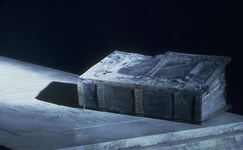
Book of Mazarbul in The Lord of the Rings: The Fellowship of the Ring

2001: Pán prsteňov (2001-2003 Slovak radio series):
- The Book of Mazarbul makes an appearance in the fifth episode of the first series, set entirely in Moria. Gandalf (portrayed by Martin Huba) begins reading from it, but the majority of the excerpts are heard as a voiceover by the deceased elderly dwarf Ori (portrayed by František Kovár), the chronicler of Balin's expedition to Moria.
2001: The Lord of the Rings: The Fellowship of the Ring:
- A detailed prop was made for the movie, with Cirth and Tengwar letters written perhaps by Daniel Reeve. The outside cover of the prop reads: "Records (of the) Longbeards of Khazad-dûm".
- The first page of the book read by Gandalf in the movie is written using Cirth (Angerthas Erebor) and Tengwar (full mode). A number of leaves before this page fall out when Gandalf opens the book. This apparently is the second to the last page.
- The text read by Gandalf in the movie differs from that of the books, and is largely based on the final two pages:
- "They have taken the Bridge and the Second Hall. We have barred the gates, but cannot hold them for long. The ground shakes... Drums. Drums in the deep. We cannot get out. A Shadow moves in the dark... We cannot get out... They are coming."
References
- ↑ J.R.R. Tolkien, Christopher Tolkien (ed.), The Peoples of Middle-earth, "X. Of Dwarves and Men", "Notes", #10
- ↑ Pictures by J.R.R. Tolkien, The Treason of Isengard and J.R.R. Tolkien: Artist and Illustrator.
- ↑ 3.00 3.01 3.02 3.03 3.04 3.05 3.06 3.07 3.08 3.09 3.10 3.11 3.12 3.13 3.14 3.15 3.16 3.17 3.18 3.19 3.20 3.21 3.22 3.23 3.24 3.25 3.26 3.27 3.28 3.29 3.30 . "The mysterious “Book of Mazarbul” reveals more". Festival Art and Books. Retrieved 11 September 2025
- ↑ 4.0 4.1 4.2 J.R.R. Tolkien, Christopher Tolkien (ed.), Pictures by J.R.R. Tolkien, 24. "Leaves from the Book of Mazarbul"
- ↑ J.R.R. Tolkien, Christopher Tolkien (ed.), The Peoples of Middle-earth, Of Dwarves and Men pp. 298-9)
- ↑ Tolkien Art Index on Tolkienists.org
- ↑ Final page of the Book of Mazarbul on Museoteca.com