


 | |
| Finn and Hengest: The Fragment and the Episode | |
|---|---|
| Publication Information | |
| Author | J.R.R. Tolkien |
| Editor | Alan Bliss |
| Publisher | George Allen and Unwin (UK) Houghton Mifflin (US) |
| Released | 20 January 1983 |
| Format | Hardcover; paperback |
| Pages | 180 |
| ISBN | 0048290033 |
Finn and Hengest: The Fragment and the Episode is an edition of J.R.R. Tolkien's lecture materials on two Old English texts that recount the "Battle of Finnsburg". The book was edited by Alan Bliss and published in 1983 (though dated 1982).[1]
The two texts in question are the "Finnesburg Fragment" and a certain episode in Beowulf, the two primary sources of the story, on which Tolkien lectured in Oxford in the 1930s. Finn and Hengest are the leaders of the two parties involved in the conflict.
Contents
- Preface
- Editor's Introduction
- Introduction
- Texts
- The Fragment; The Episode
- Glossary of Names
- The Fragment; The Episode
- Textual Commentary
- The Fragment; The Episode
- Translation
- The Fragment; The Episode
- Reconstruction
- Appendix A: The Danes
- Appendix B: The Dating of Healfdene and Hengest
- Appendix C: The Nationality of Hengest
- Summary
The "Fragment" tells the first part of the story. Hnæf, a young king, notices his troops are being assailed. Sixty men of his comitatus become trapped inside a hall. A fight ensues between the sixty men and the assailers, described as eotenas. The battle lasts five days, and only then, the first Dane dies.
The "Episode" is a passage from Beowulf (lines 1063-1159). In Heorot, a bard tells Hrothgar and his guests of the glorious Danes. The perspective lies with Hildeburh, the sister of Hnæf, and the wife of Finn. Both Hnæf and Hildeburh's son with Finn have fallen, along with most of Finn's knights. It remains unclear whether Finn was involved in the fight. Desperate, Finn pleads a bargain. As Tolkien states, it hardly was a bargain:
- Finn had lost so many men that he could not force his way into the hall again.
- The Danes were occupying his royal hall, and he was unwilling to burn it to get them out.
- Finn must have felt both guilty and ashamed that his feuding thanes had killed Hnæf, who was his brother-in-law and guest.
In the end, Hengest is compelled by his thanes to break this oath to Finn and kills him. They carry off Hildeburh and many of his treasures back to Denmark. Tolkien considers this oath-breaking to be a major reason for Hengest's "exile" to England.
- Relation to the legendarium
There are some names in these stories that Tolkien later used for Rohirrim:
From the publisher
Tolkien’s famous translations and lectures on the story of two fifth-century heroes in northern Europe.
The story is told in two Old English poems, Beowulf and The Fights at Finnesburg, but told so obscurely and allusively that its interpretation had been a matter of controversy for over 100 years. Bringing his unique combination of philological erudition and poetic imagination to the task, however, Tolkien revealed a classic tragedy of divided loyalties, of vengeance, blood and death.
Tolkien’s original and persuasive solution of the many problems raised by the story ranged widely through the early history and legend of the Germanic peoples. The story has the added attraction that it describes the events immediately preceding the first Germanic invasion of Britain which was led by Hengest himself.
This book will be of interest not only to students of Old English and all those interested in the history of northern Europe and Anglo-Saxon England, but also admirers of The Lord of the Rings who will be fascinated to see how Tolkien handled a story which he did not invent.
Publication history and gallery
- UK editions
-
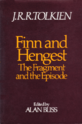
1983 hardcover
-
1998 paperback
-
2006 paperback
-
2025 paperback
-
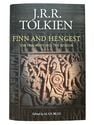
2026 hardcover (boxed set)


- George Allen and Unwin, hardcover (1983), pp. 180. ISBN 0048290033
- HarperCollins paperback (1998), pp. 192. ISBN 0261103555
- HarperCollins hardcover with reversable dustjacket (2026), ISBN 978-0008795184 (box) - (Myths & Legends #2)
References
- ↑ Wayne G. Hammond, Douglas A. Anderson (1993), J.R.R. Tolkien: A Descriptive Bibliography: B36
- ↑ The impression number in the copyright page was omitted by accident [1]