


_-_logo.jpg) | |
| The Hobbit | |
|---|---|
| Information | |
| Director | Peter Jackson[1] Andy Serkis (Second Unit Director)[2] |
| Writer | Guillermo del Toro Peter Jackson Fran Walsh Philippa Boyens[1] (screenplay) J.R.R.Tolkien (novels) |
| Producer | Peter Jackson Fran Walsh Carolynne Cunningham Philippa Boyens (Co-Producer) Ken Kamins (Executive Producer) Zane Weiner (Executive Producer)[1] |
| Starring | Ian McKellen Martin Freeman Richard Armitage See cast section below for more |
| Cinematography | Andrew Lesnie[3] |
| Editing | Jabez Olssen |
| Music | Howard Shore[3] |
| Studio | New Line Cinema MGM WingNut Films[1] |
| Distributor | Warner Bros. Pictures[1] |
| Released | An Unexpected Journey: 14 December 2012 The Desolation of Smaug: 13 December 2013 The Battle of the Five Armies: 17 December 2014[4][5] |
| Runtime | 474 minutes (Theatrical Edition) 532 minutes (Extended Edition) |
| Country | New Zealand United Kingdom United States |
| Language | English |
| Website | Official Blog |
An Unexpected Journey, The Desolation of Smaug, and The Battle of the Five Armies, known collectively as The Hobbit, are three live-action films based upon J.R.R. Tolkien's 1937 novel of the same name, although elements from The Lord of the Rings books are also used.[1][4] All three films were directed by Peter Jackson and they were conceived as prequels to Jackson's earlier project, The Lord of the Rings (film series).[3][6]
Martin Freeman plays the films' title role of Bilbo Baggins.[3] Thorin Oakenshield is portrayed by Richard Armitage,[3] and Benedict Cumberbatch plays the dragon Smaug.[7] Several cast members from The Lord of the Rings (film series) reprise their roles, including Ian McKellen as Gandalf the Grey, Cate Blanchett as Galadriel, Andy Serkis as Gollum, Hugo Weaving as Elrond, Christopher Lee as Saruman, Orlando Bloom as Legolas and Elijah Wood as Frodo.[3]
Filming in New Zealand began on 21 March, 2011 and ended on 6 July, 2012;[8][9] Like The Lord of the Rings: The Motion Picture Trilogy, The Hobbit films were produced back-to-back and released over three consecutive years: An Unexpected Journey was released in North America on 14 December, 2012, The Desolation of Smaug on 13 December, 2013, and The Battle of the Five Armies on 17 December, 2014.[1][4][5]
Peter Jackson initially planned to produce two films, but following the conclusion of principal photography, and on seeing early cuts of these films, he decided that he wanted 'to tell more of the tale'. Therefore on 30 July, 2012, Jackson announced that 'two films will become three'.[6][10]
Plot
The three Hobbit films follow the plot from J.R.R. Tolkien's The Hobbit in addition to added details revealed in the Appendices to The Lord of the Rings.
For more specific information see the plot section for each respective film:
Early Development
Origins
Peter Jackson and Fran Walsh first considered the possibility of filming The Hobbit and The Lord of the Rings somewhere between November 1995[11] or February 1996.[12] Jackson had at that time not read The Hobbit, but started reading it after Walsh suggested they start with that book.[13]
They hoped to produce three films, the first based on The Hobbit, with the second and third films being adaptations of The Lord of the Rings. Rights to The Hobbit proved difficult to secure because whilst Saul Zaentz owned the production rights, United Artists held the distribution rights. Although some concept art[14] and computer programming[15] had began at the time, any attempt to cooperate with or buy the rights from United Artist fell apart due to their parent company, Metro Goldwyn-Mayer, going through bankruptcy.
After much wrangling with studios and the script, filming began for the three-film adaptation of The Lord of the Rings, with The Hobbit as a potential prequel.[16] Much work relevant to The Hobbit or prefiguring it was accomplished during this period: the first draft of The Lord of the Rings had Merry, Sam and Pippin, having eavesdropped over the Bag End door, all tumble in when Gandalf opened the door, similarly to the Dwarves in An Unexpected Journey.[17] Bag End was primarily designed based on its descriptions in The Hobbit and Howe's illustrations of it, and Jackson kept both that set and that of Elrond's study in storage.[18] Early storyboards for the prologue of Fellowship of the Ring depicted Khazad-dum in its heyday in shots that distinctly recall the Erebor montage in An Unexpected Journey. The Orcs attacking the fellowship on the Anduin was designed as a white-rapids sequence similar in outline and storyboarded details to the barrel sequence in The Desolation of Smaug.[19] Elements of Arwen, as originally scripted and shot, prefigure Tauriel.
Although in 2000 Jackson told Wood that he was "not interested" in directing The Hobbit,[20] by late 2002 he had discussed making The Hobbit and another film bridging the gap to Lord of the Rings.[21][22] The next year, Philippa Boyens saw Martin Freeman at the BAFTAs and told Jackson and Walsh that "he'd be a fantastic Bilbo."[23] At the time of the Return of the King premiere that year, Jackson discussed incorporating Arwen into The Hobbit, as well.[24] By 2004, it was expected that these two films would proceed in "in some short order."[25]
After The Lord of the Rings
Following a dispute on remunerations from Lord of the Rings trilogy, Jackson sued New Line Cinema in 2005[26] and the subsequent dispute led to him being relieved from The Hobbit and the putative "bridge" film,[26] with New Line Cinema courting Sam Raimi to direct. In 2006, Jackson spoke about making The Hobbit: "At that implied stuff with Gandalf and the White Council and the return of Sauron could be fully explored. [...] There's actually a role for Legolas in THE HOBBIT, his father features in it, obviously Gandalf and Saruman should be part of it. There's things that you can do with THE HOBBIT to bring in some old friends, for sure. I have thought about it from time to time... Elrond, Galadriel and Arwen could all feature."[27]
Since production involved cooperating with MGM, in 2007 CEO Harry Sloan asked to meet Jackson and Walsh (then in town for the Golden Globes) to explain the situation. Jackson outlined - apparently, in considerable detail - their plan for the two films. After their conversation, Sloan told New Line CEO Robert Shaye that "You have a Peter Jackson problem. Fix your Peter Jackson problem."[28] Furthermore, other parties from Raimi, producer Saul Zaentz and the actors were expressing unwillingness to proceed without Jackson.
Development
By December, it was announced Jackson would write and executive produce The Hobbit with Walsh and Boyens. The two films were tentativelly budgeted at $150 million and scheduled for release in 2011 and 2012. Although Robert Shaye and Michael Lynne (still attached as executive producers, although their contracts were soon to expire) claimed Jackson hadn't ruled out directing the films, he decided to approach a director of his choosing.[29] Says Jackson:
If I were to make these films, I would be frustrated because I would be constantly thinking about what I had done on The Lord of the Rings. I would somehow feel that I had to build or improve on that. I thought it would be a fairly unsatisfying experience to have to compete against my own movies.
Having worked together on a putative adaptation of the game Halo, Jackson chose Guillermo del Toro to direct the films, approaching him that month. Jackson would still write and produce, and even aired the idea of shooting second unit if necessary.[31] Story conferences with del Toro began in April 2008: they video-conference regularly, and fly-in to meet in Los Angeles or Wellington every three weeks. During their first script meeting, "we talked about Dol Guldur," recalls Philippa Boyens.[32] They had also "sketched" their ideas for the second, "bridging" film, although it remained very sketchy until September.
Already at this point, major talent was attached, including Ian Mckellen[33], Alan Lee, John Howe, Gino Acevedo and Weta Workshop;[34] Howard Shore[35], Dan Hennah[36] and Mark Ordesky.[37] Andy Serkis, Ian Holm[38] Martin Freeman[39] and del Toro's regular collaborators Guillermo Navarro, Wayne Barlowe, Mike Mignola, Ron Perlman, Doug Jones and Francisco Ruiz Velasco[40] were also being sought beginning at this time.
del Toro had hoped to direct the films without restorting to second unit at all. This would entail a shooting schedule which del Toro estimated at 370 days long.[41] This was to include a long break to re-orient themselves from The Hobbit to the bridge film, which involved immersing himself in The Lord of the Rings films (del Toro claimed he'd watch dailies[42]) and recreating old sets. del Toro had expressed concern about the extended time commitment of the project: "I'll be in voluntary exile in new Zealand for four years! So Saturn wouldn't happen immediately. I'm gonna be almost 50 by the time I'm done!"[43] There were also concerns about the physical demands of an extended shoot including work in remote locations: Jackson advised him to lose weight, especially after del Toro gained weight thanks to the New Zealand culinary scene.[44]
By November, del Toro had arrived to New Zealand for extended work on the story treatment, at which point the contents of the second film were beginning to shrink. The idea seems to have always been to incorporate the tail end of The Hobbit (after Smaug's death, del Toro said in July[45]) into the second film and create five undifferentiated entries in one series. Now, the contents of this second film start to shrink in favour of an ever-expanding adaptation of The Hobbit itself. By the time the story treatment was complete in early 2009, the films were essentially a two-part adaptation of The Hobbit,[46] although elements of the bridge film endured as late as mid 2011.
del Toro's version
del Toro had began writing the scripts with Jackson, Walsh and Boyens. Except for elements that were later excised, most of them pertaining to the "bridge" film, this draft was done on the same specs as the finished film: this included expanding the roles of the Dwarves, the Silvan Elves and the Men of Laketown as well as incorporating the White Council and Dol Guldur, as well as much of the Dwarven backstory including Azanulbizar. del Toro had also advocated for the inclusion of the chance meeting in Bree, which was later written out but then reinstated in pickups for The Desolation of Smuag.[47]
They had discussed adding female characters: since one of the aims of the bridge film was to tell how Frodo came into Bilbo's custody, they had considered a female hobbit in the guise of Primula Brandybuck. They also opted to give Bard a wife, but del Toro insisted on a warrior character. Walsh suggested "she should be an Elf."[48] They had already discussed bringing Arwen into the story,[24] and now concieved the character of Itarille ("Starlight") who would fall in love with an Elven emissary from Rivendell.[49]
As del Toro began designing the films, he hit upon a radically different design aesthetic, with the intention of gradually affecting a transition to a style more closely resembling Jackson's The Lord of the Rings films. Hobbiton was already being rebuilt in permanent materials,[50] but del Toro added a four extra holes beside Bag End for a shot he had in mind for the opening of the film. Some design elements ended up close to what is seen in the trilogy: Jackson cites the Stone Giants, Mirkwood and Laketown as examples. Goblintown, by contrast, seems to have been inspired more by Giger, with entrapments fashioned like grimacing faces dropping unwitting prisoners into a wringer to feed the Goblins.[51] Erebor was to have del Toro's persistent clockwork motif and steampunk look, while the Woodland Realm was to be more oriental.
Guillermo had also discussed casting Ian McShane, Brian Blessed and Brian Cox as Dwarves, the latter as Balin. Jackson had proposed Martin Freman for Bilbo[23] and Sylvester McCoy for Radagast. While meeting Serkis (working on The Adventures of Tintin), he discussed him playing the Great Goblin in addition to Gollum.[52]
Continuing delays
Besides the delays involved in Jackson's dispute with New Line and his preceding involvement with The Lovely Bones, several other factors contributed to further delays: To begin with, production of The Hobbit films was held up by the Tolkien Estate's legal action against New Line Cinema. The Estate should have received 7.5 per cent of all profits from the films under the agreement made by J.R.R. Tolkien with United Artists in 1969. Crucially, they also sought to stop the production of The Hobbit films until the case was settled.[53] The legal row was finally settled in September 2009 after the Tolkien Estate successfully sued New Line Cinema for breach of contract and fraud, receiving a reported $220 million in compensation.[54]
The estate has [...] asked for a court order giving them the ability to terminate any rights the studio have to make films based on other Tolkien works, including The Hobbit.
Even before the issue of the directorship had been settled, and before the project was given the go-ahead by the studios, the International Federation of Actors (IFA) told actors to actively avoid participation in the production of The Hobbit films.[55] The IFA issued this "Do Not Work Order", on 24 September, 2010, on the basis that the studios refused to engage in union-negotiated contracts.[56] Meanwhile the studios argued that they could not make an agreement with a trade union under New Zealand law.[55]
Peter Jackson subsequently warned that the dispute could lead to a huge delay and that production could easily transfer to Eastern Europe.[57] John Key, the incumbent Prime Minister of New Zealand, weighed in on the dispute saying that he hoped the dispute would not force The Hobbit production to move overseas. He also announced that the New Zealand government had gotten involved in the discussions.[58]
Whilst the studios announced that filming would begin the following February,[59] the dispute remained unsettled. With the studios seriously considering moving the production abroad, large numbers of New Zealanders protested in Auckland, Wellington, and Christchurch.[60] A settlement was finally reached on 27 October, 2010, with the Prime Minister himself announcing the news, hoping to prevent the loss of jobs in New Zealand and to reinforce the country's Tolkien tourism industry.[61] As part of the agreement, the New Zealand government passed legislation which clarified that film industry workers are independent contractors rather than employees.[62]
Most importantly, due to cycles of bankruptcy, MGM could not conclude a deal with New Line Cinema for the rights, and the films could therefore not be greenlit. Due to these ongoing delays, it was revealed on 30 May 2010 that del Toro could no longer commit himself to direct The Hobbit films, citing the continued delays in production in his reasoning.[63] On 15 October of the same year it was announced that Peter Jackson would direct both films.[64]
Preproduction
Jackson, Walsh and Boyens had spent 18 months writing the script with del Toro.[20] Walsh remembers producing one draft, and Jackson likewise remembers that del Toro only got "part of the way through" prepping The Hobbit. By the point he left, some $60 million[52] had been spent in development. Jackson had taken three weeks to consider his options: they had proposed bringing other directors onboard but executive producer Alan Horn was adamant that, as producer, Jackson ought to take the director's chair. MGM still being in bankruptcy (causing similar delays on the production of Skyfall) meant the films were still not greenlit, but difficulties involved in making approaches to actors galvanized Jackson to officially confirm his taking the director's seat.
This shift involved overhauling much of del Toro's design work. In several cases, as with the Silvan army, Jackson had found designs more to his likings in concept art that had been drawn for del Toro and rejected. What's more, Jackson had only a few weeks to get his storyboards in order, although in the event a further delay incurred by a perforated ulcer he suffered from, had earned him three more months.[23] This preproduction crunch had been posited as an issue that plagued production, although doubt had been cast on this based on production materials.[65] The director of the making-ofs, Michael Pellerin, had pointed out that this issue was propped by clips from the making-ofs having been edited out of context for YouTube:
I saw those edits they do where they cut together things and they make it look like Peter's saying 'I don't know what I was doing.' But it's malicious because what it does is it takes people's good will - like Peter's good will - and saying "I'm going to be honest with you and tell you why the battle got moved. And that's what that piece was about. [...] But instead somebody takes it and takes those comments out of context, and makes it sound like 'That's what Peter was saying about the whole film!' That's ridiculous! First of all, it's not true.
Jackson continued casting roles. Although the exiting del Toro made a call to Martin Freeman to tell him he is still their choice for the role and he auditioned, they had also looked at other possible actors including Dean O'Gorman, Adam Brown, James McAvoy and Eddie Redmayne. Freeman had signed on to a second season of Sherlock, and Jackson looked back at some of those audition tapes but decided to rejig the schedule to retain Martin.
For auditioning the Dwarves, they put lines for all the different parts under the audition for Gloin. They had wanted Ken Stott for Balin, but also auditioned Peter Mullan. William Kircher and John Callen auditioned for the Master of Laketown and Radagast, respectively, but since they wanted Stephen Fry and Sylvester McCoy for those roles, they were cast as Bifur and Oin. Aidan Turner auditioned for the "Elf lord" who is the love interest of Itarille, but after the part got written out he was cast as Kili and the love story "migrated" with him: for Tauriel they wanted Evangeline Lilly but since she had just given birth, they also auditioned Lily Collins and Eva Green. Ryan Gage initially auditioned for Alfrid, but also auditioned for Gloin and was cast as Drogo Baggins, a role he remained attached to until May 2011. The major roles were announced between October 2010 and March 2011.
Production
Filming finally began on 21 March, 2011.[8] It was originally scheduled for 254 days in three blocks, although after the first block this was extended to 266 days, wrapping in 6 July 2012.[9] The shoot was somewhat chronological, starting in Gollum's cave before reverting to the Bag End interior scenes. This particular sequence involved a 100-second oner with two camereas slaved together to match the scale of Gandalf and the Dwarves, and took two days to shoot. At the time, Ian McKellen was still "finding his way back" into Gandalf and - having already found the green-screen scenes difficult in The Lord of the Rings - had a breakdown on one of the takes but was ameliorated by Jackson and producer Zane Weiner. Second unit also started shooting at this time under Andy Serkis.
_-_Peter_Jackson_Filming.jpg)
This was followed by Trollshaws and Rivendell - at which point Martin Freeman left to shoot the second season of Sherlock. The time crunch involved a last-minute redressing of the Trollshaw set, which the entire crew chipped in to accomplish between shots, while stairs were added overnight to the White Council set to allow Galadriel's long dress to drape over the steps.
Around this time, the entire White Council and Dol Guldur storyline were filmed.[66] This also involved filming at Pinewood Studios in the United Kingdom in July, 2011. Using their F Stage and N&P Stages, the production filmed scenes with Christopher Lee and Ian Holm who could not fly to New Zealand.[67][68]
Block two included more Shire scenes (e.g. Old Took's birthday party) before they set out for eight weeks on location. This started with the exterior shots of Hobbiton. In November, they started shooting with Evangeline Lilly on the shores of Laketown: as originally scripted, Tauriel was to kiss Kili here, but during a read-through in the hotel before shooting Lilly proposed delaying this beat. Later, crew helicopeted into the Rock and Pillar range to shoot the company's search for the hidden door, but encroaching mists led to a few crew members getting stranded on the mountain: they had to walk downhill onfoot until they were well below the clouds.
Block three involved shooting with Benedict Cumberbatch as Smaug (motion-capture), the destruction of Laketown and death of the Master, and the Erebor scenes. By this point, Jackson had started to fall behind in terms of storyboarding and the set construction was getting "crunched." They were due to shoot the battle scenes outside Erebor, but Jackson decided to reschedule those to the 2013 pickups to allow more time to previsualize the sequences. The shoot wrapped with scenes of Gandalf and Radagast, having sprung Beorn from incarceration in Dol Guldur, trying to convince him to help them.
Pickup shoots for the first film proceeded almost immediately, beginning in 16 July and ending on the 28th. This involved a few inserts for Azog: as originally shot, it wasn't revealed that Azog had survived until he waylays the company in the Forest ledge, and the full backstory was only told at Beorn's. Having redesigned Azog in the meanwhile, they had cast Manu Bennet to play the character on the motion capture stage. They had also shot Bilbo rescuing Thorin and a more emphatic conclusion to their animosity in the Carrock.
Post Production
They had began work on some sequences in 2010, namely the Barrel chase since it was originally the climax of the first film. The Troll sequence was also begun early, with three of the Dwarf actors doubling as the Trolls by motion capture on the side of the live-action set. The films were somewhat rejigged in editing: the High Fells sequence was originally in An Unexpected Journey - the storm clouds Gandalf sees are the ones that assail the Company on the High Pass - but was moved to The Desolation of Smaug.
They had scheduled pickups for the second of two films in 2013. When the decision was made to expand to three films (below) the pickups were extended from the scheduled six weeks to ten[69] with the intention of covering materials for both the second and the third film. This involved shooting the (much revamped) battle scenes, including the entire climax on Ravenhill, the Bree scene and the confrontation with Smaug that concludes The Desolation of Smaug.
Film Three
The original plan was to produce two films, entitled The Hobbit: An Unexpected Journey and The Hobbit: There and Back Again (to be released in 14 December 2012 and 13 December 2013 respectively).[1] Even so, there were doubts that the scope of the project would fit in two films. In 2009, del Toro said it's "barely containable in two films." When Mike Mignola arrived in New Zealand he said it looked like "a 16-hour movie." When Jackson scheduled the films and it came to a 250-day schedule, similar to The Lord of the Rings, it gave him pause.
Editor Jabez Olssen had been producing an assembly while shooting, enabling Jackson to review a rough cut of the footage around May 2012 with Boyens and Walsh.[70] By June, they had met to "talk about the shape of the two films."[71] Jackson later revealed that "it never structurally felt quite right, where [film] one finished" which was to be on the silhuette of Bard holding the company at the point of his arrow. He had also felt there was a lack of confrontation between Thorin and Smaug. "What", he wonder aloud, "if it was a trilogy?"[71][69] They had created a treatment that reorganized the scenes, as scripted and shot, into three films: this was divulged to the lead actors[72] but not to the executive producers until they arrived to congradulate Jackson on the event of the wrap party.[73] During pickups, Walsh and Boyens flew to Los Angeles to break down the pitch.[69]
At San Diego Comic-Con International of 2012, Peter Jackson revealed that he hoped to film more material (based on The Appendices) in 2013; this led to speculation that there could be a third "Hobbit" film. On 30 July, 2012, Peter Jackson announced that there would indeed be a third "Hobbit" film. After watching the early cuts of the first two films, Jackson, Walsh and Boyens decided that they wanted to tell more of the story.[6]
We know how much of the story of Bilbo Baggins, the Wizard Gandalf, the Dwarves of Erebor, the rise of the Necromancer, and the Battle of Dol Guldur will remain untold if we do not take this chance. The richness of the story of The Hobbit, as well as some of the related material in the appendices of The Lord of the Rings, allows us to tell the full story of the adventures of Bilbo Baggins and the part he played in the sometimes dangerous, but at all times exciting, history of Middle-earth.
On 31 August, 2012, it was revealed that the titles of the second and third films would be The Hobbit: The Desolation of Smaug and The Hobbit: There and Back Again respectively. The release of the first and second film remained unchanged, whilst the third film was due for release on 17 December, 2014 (moved from the initial release date of 18 July, 2014).[4][5]
On 24 April, 2014, Peter Jackson revealed that the final film would be re-titled The Hobbit: The Battle of the Five Armies.[74]
Technical details
3D

The Hobbit: An Unexpected Journey, The Hobbit: The Desolation of Smaug, and The Hobbit: The Battle of the Five Armies were filmed in 3D using RED Epic cameras. A rig designed by 3ality Technica is being used in the filming of the three films; here two cameras and a mirror are used in order to achieve an intraocular effect similar to that of a human's (the distance between the eyes). This is how the depth required for 3D film is achieved.[75]
Most of John Howe's and Alan Lee's concept art has continued to be produced in 2D. However, they have collaborated on 3D pieces using the simple red and blue 3D effect.[75]
48 frames per second
Breaking with conventional filming techniques, The Hobbit: An Unexpected Journey, The Hobbit: The Desolation of Smaug, and The Hobbit: The Battle of the Five Armies are being filmed by capturing 48 frames per second (FPS), twice the normal film standard of 24 frames per second. When describing what people thought when they saw clips of The Hobbit shown at 48 frames per second, Peter Jackson said that it's 'like the back of the cinema has had a hole cut out of it where the screen is and you're actually looking into the real world'.[75]
Jackson later discussed the advantages of filming at higher frame rate and in 3D.
Now, in the digital age, there’s no reason whatsoever to stick to 24 fps. [...] Science tells us that the human eye stops seeing individual pictures at about 55 fps. Therefore, shooting at 48 fps gives you much more of an illusion of real life. The reduced motion blur on each frame increases sharpness and gives the movie the look of having been shot in 65mm or IMAX. One of the biggest advantages is the fact that your eye is seeing twice the number of images each second, giving the movie a wonderful immersive quality. It makes the 3D experience much more gentle and hugely reduces eyestrain. Much of what makes 3D viewing uncomfortable for some people is the fact that each eye is processing a lot of strobing, blur and flicker. This all but disappears in HFR 3D.
Additionally, the The Hobbit films are being filmed at a 5K resolution. This is substantially larger than the conventional 1080 HD resolution. The films are being filmed digitally onto 128 GB memory cards that fit into the RED Epic camera.[75]
One of the drawbacks of filming 48 frames per second at 5K resolution is that the make-up, prosthetic, prop, set, and costume departments have to work differently. For example, the make-up and prosthetic departments have to redden up the faces of the actors much more than usual because otherwise their skin colour will turn up yellow on the final film. Furthermore, real hair has to be used in order to achieve an authentic look when it moves around.[75]
Ten minutes of footage was shown at 48 FPS during the Warner Bros. presentation at CinemaCon 2012. The reaction was mixed. The Los Angeles Times described the picture as 'hyper-realistic' and the Associated Press described 'vivid, with grass blades, facial lines and soaring mountains appearing luminous and pronounced. The actors looked almost touchable, as if they were performing live on stage'. However, an anonymous projectionist said that '[i]t looked like a made-for-TV movie'.[77][78]
Games and merchandise
Video games
In late 2011, the Los Angeles Times reported that Warner Bros. Interactive Entertainment would release a video game based on The Hobbit in lieu of the release of The Hobbit: An Unexpected Journey in December 2012.[79] However, this game was never released.
In September 2012, Warner Bros. Interactive Entertainment announced that it would produce two free-to-play video games, in co-operation with Kabam.
- The first, a mobile-phone game named The Hobbit: Kingdoms of Middle-earth, was released in November 2012. In this game the player is able to manage his own kingdom and play as either Elves or Dwarves.[80][81]
- The second, a strategic browser-based game called The Hobbit: Armies of The Third Age, allows the player to play as either the Elves, Dwarves or Orcs (including several heroes from The Hobbit films). It was eventually released on 2013, but it was discontinued on June 20, 2014.[80][82]
Guardians of Middle-earth, a "Multiplayer Online Battle Arena" video game by Monolith Productions, includes some playable characters ("guardians") from The Hobbit films. Additional The Hobbit "guardians" were added after the release of The Hobbit, to tie in with the films.[83]
Lego
On 17 December, 2011, it was announced that the Lego Group had received the rights to create Lego sets based on The Lord of the Rings and The Hobbit: An Unexpected Journey. The first sets on The Hobbit were released in the end of 2012.[84]
People involved
- Production - New Line Cinema[3]
- United States Distribution - Warner Brothers[3]
- International Distribution - MGM[3]
- Director - Peter Jackson[3]
- Second Unit Director - Andy Serkis[2]
- Producers - Peter Jackson, Fran Walsh, and Carolynne Cunningham[3]
- Co-Producer - Philippa Boyens[3]
- Executive Producers - Ken Kamins and Zane Weiner[3]
- Screenwriters - Peter Jackson, Fran Walsh, Philippa Boyens, and Guillermo del Toro[3]
- Director of Photography - Andrew Lesnie[3]
- Production Designer - Dan Hennah[3]
- Conceptual Designers: Alan Lee and John Howe[3]
- Composer - Howard Shore[3]
- Make-up and Hair Designer - Peter King[3]
- Costume Designers - Ann Maskrey and Richard Taylor[3]
- Design and production of weaponry, armour, and prosthetics - Weta Workshop overseen by Richard Taylor[3]
Main cast
_-_cast.jpg)
Gallery
Pictures from the production of The Hobbit films
-

Martin Freeman as Bilbo Baggins in Bag End.
-

-
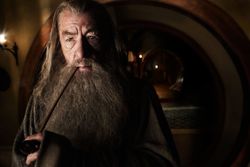
Gandalf in Bag End.
-

Peter Jackson on the set of Bag End.
-

Martin Freeman and Peter Jackson on the set of Bag End.
-

Peter Jackson on the set of Bag End.
-

The thirteen dwarves.
-

-

-

-

-

-


_-_Gandalf_the_Grey.jpg)

_-_Peter_Jackson_in_Bag_End_1.jpg)
_-_Martin_Freeman_and_Peter_Jackson.jpg)
_-_Peter_Jackson_in_Bag_End_2.jpg)
_-_the_Dwarves.jpg)
_-_Nori,_Ori_and_Dori.jpg)
_-_%C3%93in_and_Gl%C3%B3in.jpg)
_-_F%C3%ADli_and_K%C3%ADli.jpg)
_-_Bombur,_Bofur_and_Bifur.jpg)
_-_Balin_and_Dwalin.jpg)
_-_Thorin.jpg)
See also
- The Hobbit (film series)
- The Hobbit
- Images from The Hobbit (film series)
External links
- TheHobbit.com (official website)
- TheHobbitBlog.com (official blog)
- Peter Jackson's Facebook page
Notes
- ↑ Conan Stevens was initially cast as Azog. (see: . "Casting News for The Hobbit". Facebook. Retrieved 21 December 2011).
- ↑ Oscar Strik portrays Little Bilbo only in the Extended Edition of The Hobbit: An Unexpected Journey.
- ↑ Ryan Gage was initially cast as Drogo Baggins. (see: . "Ryan Gage Tweets About Hobbit “Costume Fitting”". TheOneRing.net. Retrieved 2 August 2012).
- ↑ Conan Stevens is credited to play Bolg in a brief, unidentified appearance in The Hobbit: An Unexpected Journey. (see: . "Exclusive: ‘Hobbit’s’ Conan Stevens chats with TORn". TheOneRing.net. Retrieved 2 August 2012).
- ↑ Antony Sher portrays Thrain only in the Extended Edition of The Hobbit: The Desolation of Smaug.
- ↑ Rob Kazinsky was initially cast as Fíli. (see: . "Casting news!". Facebook. Retrieved 21 December 2011
References
- ↑ 1.0 1.1 1.2 1.3 1.4 1.5 1.6 1.7 "Titles and Release Dates Announced". The Hobbit Blog. Retrieved 21 December 2011
- ↑ 2.0 2.1 "Andy Serkis to serve as Second Unit Director". The Hobbit Blog. Retrieved 21 December 2011
- ↑ 3.00 3.01 3.02 3.03 3.04 3.05 3.06 3.07 3.08 3.09 3.10 3.11 3.12 3.13 3.14 3.15 3.16 3.17 3.18 3.19 3.20 3.21 3.22 3.23 3.24 3.25 3.26 3.27 3.28 3.29 3.30 3.31 3.32 3.33 3.34 3.35 3.36 3.37 3.38 . "Production begins in New Zealand on The Hobbit". Facebook. Retrieved 21 December 2011
- ↑ 4.0 4.1 4.2 4.3 "The Hobbit Trilogy titles and release dates". The Hobbit Blog. Retrieved 2 September 2012
- ↑ 5.0 5.1 5.2 "Third ‘Hobbit’ movie release moved from July to December 2014". TheOneRing.net. Retrieved 1 March 2013
- ↑ 6.0 6.1 6.2 6.3 . "An unexpected journery". Facebook. Retrieved 20 July 2012
- ↑ 7.0 7.1 7.2 7.3 7.4 . "The Hobbit Casting Update". Facebook. Retrieved 21 December 2011
- ↑ 8.0 8.1 "Hobbit filming finally under way". BBC News. Retrieved 21 December 2011
- ↑ 9.0 9.1 . "We made it!". Facebook. Retrieved 6 July 2012
- ↑ . "PETER JACKSON’S LONG-AWAITED FILMED ADAPTATION OF THE HOBBIT TO BE A TRILOGY". Facebook. Retrieved 30 July 2012
- ↑ Brian Sibley, Peter Jackson: A Filmmaker's Journey (London: HarperCollins, 2005), pp. 310-323.
- ↑ Ian Nathan, Anything You Can Imagine: Peter Jackson and the Making of Middle-earth (London: HarperCollins, 2019), p. 73.
- ↑ @VillageGR, "THE HOBBIT - Interviews ( P. Jackson - P.Boyens)", Youtube, 21 December 2012.
- ↑ Nerd of the Rings, "Daniel Falconer talks designing Lord of the Rings, Guillermo del Toro's Hobbit, Wētā, and more!," Youtube, 1 February 2022.
- ↑ Nathan, p. 672.
- ↑ . ""20 QUESTIONS WITH PETER JACKSON - PART 2"". Ain't It Cool News
- ↑ Sibley, p. 366.
- ↑ J. W Braun, The lord of the films : the unofficial guide to Tolkien's Middle-Earth on the big screen (Toronto : ECW Press, 2009), p. 20.
- ↑ Michael Pellerin, "Barrels out of Bond," Peter Jackson, The Hobbit Motion Picture trilogy (Warners: 2015).
- ↑ 20.0 20.1 Michael Pellerin, "The Road Back to Middle-earth," Peter Jackson, The Hobbit: The Motion Picture Trilogy (Warners, 2015).
- ↑ . "Peter Jackson and Fran Walsh Talk THE HOBBIT". TheOneRing.net
- ↑ . "INTERVIEW: Howard Shore (“The Lord of the Rings”)". Rhino
- ↑ 23.0 23.1 23.2 Michael Pellerin, ""Mr. Baggins: The 14th Member", Peter Jackson, The Hobbit: An Unexpected Journey (Warners: 2013).
- ↑ 24.0 24.1 . "Peter Jackson mulls Rings prequel". EW
- ↑ Nathan, p. 827.
- ↑ 26.0 26.1 "Director sues over Rings profits". BBC. Retrieved 11 February 2012
- ↑ . "Part 5: Quint and Peter Jackson talk THE HOBBIT and a potential return to low budget horror!!!". Ain't It Cool News
- ↑ Nathan, p. 863.
- ↑ "Jackson to produce Hobbit movies". BBC. Retrieved 11 February 2012
- ↑ 30.0 30.1 30.2 30.3 30.4 Brian Sibley, The Hobbit: An Unexpected Journey: Official Movie Guide (2012)
- ↑ "Del Toro to direct Hobbit movies". BBC. Retrieved 11 February 2012
- ↑ Peter Jackson and Philippa Boyens, "Director's Commentary," Peter Jackson, The Hobbit: An Unexpected Journey (Warners: 2013).
- ↑ . "Hard Hobbit to break: McKellen set for return as Gandalf". The Guardian
- ↑ . "Del Toro Interview Part 3: “I Love New Zealand!”". TheOneRing.net
- ↑ . "Howard Shore is Working on Hobbit Score". TheOneRing.net
- ↑ . "An Unexpected Journey: Quint on the set of The Hobbit Part 3 – Beginnings and Endings". Ain't It Cool News
- ↑ . "Shaye kept New Line afloat". Variety
- ↑ . "Guillermo Del Toro Addresses 'Hobbit' Fans' Concerns, Talks Possible Casting". Premiere.com
- ↑ In "The Road Back to Middle-earth", Peter Jackson, The Hobbit (New Line Cinema: 2015), Philippa Boyens recalls proposing Freeman as Bilbo Baggins when she saw him at the 2003 BAFTAs.
- ↑ . ""Del Toro talks 'Hobbit' in Live Chat"". BilboHobbit.com
- ↑ . "GUILLERMO DEL TORO ESCAPES 'LABYRINTH' AND ENDS RIGHT BACK INTO 'HELLBOY'". iFMagazine
- ↑ . "EXCL: Del Toro on Hellboy II and The Hobbit". Coming Soon.net
- ↑ . "EXCL: Del Toro on Hellboy II and The Hobbit". Coming Soon.net
- ↑ . "EXCL: Del Toro on Hellboy II and The Hobbit". Coming Soon.net
- ↑ . "'Hobbit' Films Will Be One 'Continuous Journey,' Promises Guillermo Del Toro". MTV
- ↑ . "Peter Jackson speaks". TheOneRing.net
- ↑ Peter Jackson and Philippa Boyens, "Director's Commentary," Jackson, The Hobbit: The Desolation of Smaug (Warners: 2013) and Michael Pellerin, "A chance meeting," ibid.
- ↑ Pellerin, "Tauriel: Daughter of the Forest," Peter Jackson, The Hobbit: Motion picture trilogy (Warners: 2015).
- ↑ . "Hobbit - Official Casting Call and Plot Details". SpoilerTV
- ↑ . "Exclusive: Guillermo del Toro on 'Hellboy II'". Premiere
- ↑ Francisco Ruiz Velasco, "The hobbit, environment ideas and explorations," Artstation, 2020.
- ↑ 52.0 52.1 Nathan, pp. 878 ff.
- ↑ 53.0 53.1 "Rings film studio sued for $150m". BBC. Retrieved 11 February 2012
- ↑ "Legal path clear for Hobbit movie". BBC. Retrieved 11 February 2012
- ↑ 55.0 55.1 "Union tell actors to avoid Hobbit films". BBC News. Retrieved 31 July 2012
- ↑ "FIA Do Not Work Order: 'The Hobbit'". The American Federation of Television and Radio Artists. Retrieved 31 July 2012
- ↑ "Peter Jackson threatens Hobbit shutdown". BBC News. Retrieved 31 July 2012
- ↑ "Hobbit movie 'should stay in New Zealand' says PM". BBC News. Retrieved 31 July 2012
- ↑ "The Hobbit to begin filming in February next year". BBC News. Retrieved 31 July 2012
- ↑ "New Zealanders rally behind Hobbit shoot". BBC News. Retrieved 31 July 2012
- ↑ "The Hobbit will be made in New Zealand, PM confirms". BBC News. Retrieved 31 July 2012
- ↑ "Hobbit legislation passed in New Zealand". BBC News. Retrieved 31 July 2012
- ↑ "Guillermo del Toro 'leaves' as director of The Hobbit". BBC News. Retrieved 11 February 2012
- ↑ "The Hobbit gets green light, Jackson to direct". NZ Herald News. Retrieved 11 February 2012
- ↑ . ""'I had almost a year to have more thinking time': Why the "no preproduction time" argument for The Hobbit is a red herring"". Reddit
- ↑ . "THE HOBBIT, Production Video #7". Facebook. Retrieved 6 June 2012
- ↑ "The Hobbit at Pinewood". Pinewood Studios. Retrieved 2 August 2012
- ↑ . "THE HOBBIT, Production Video #3". Facebook. Retrieved 2 August 2012
- ↑ 69.0 69.1 69.2 Ian Nathan, 'An Unexpected Trilogy', Empire, 282 (December 2012)
- ↑ . "Philippa Boyens interview: The Hobbit trilogy, Tolkien, 48fps and more". Den of the Geek
- ↑ 71.0 71.1 Nathan, p. 914.
- ↑ . "Richard Armitage: Why The Hobbit Trilogy Should Have Been LONGER". Yahoo!
- ↑ . http://www.latimes.com/entertainment/envelope/cotown/la-et-ct-hobbit-third-movie-jackson-20120724,0,2208206.story. Los Angeles Times. Retrieved 26 July 2012
- ↑ . "The 3rd ‘Hobbit’ Film Now Retitled ‘The Hobbit: The Battle of the Five Armies’". The Playlist. Retrieved 3 February 2016
- ↑ 75.0 75.1 75.2 75.3 75.4 . "THE HOBBIT, Production Video #4". Facebook. Retrieved 10 February 2012
- ↑ . "Q&A ON HFR 3D". Facebook. Retrieved 19 November 2012
- ↑ "Peter Jackson unveils new Hobbit footage". BBC News. Retrieved 31 July 2012
- ↑ "CinemaCon: Footage of 'The Hobbit' draws mixed reaction". Los Angeles Times. Retrieved 31 July 2012
- ↑ . "Warner's approach to video games is paying off". Los Angeles Times. Retrieved 2 March 2012
- ↑ 80.0 80.1 . "Warner Bros. Announces The Hobbit Games". IGN. Retrieved 24 November 2012
- ↑ "THE HOBBIT: KINGDOMS OF MIDDLE-EARTH". Kabam. Retrieved 24 November 2012
- ↑ "THE HOBBIT: ARMIES OF THE THIRD AGE". Kabam. Retrieved 24 November 2012
- ↑ "Game Info". Guardians of Middle-earth. Retrieved 24 November 2012
- ↑ "Building sets based on THE LORD OF THE RINGS™ Trilogy and the Two Films Based on THE HOBBIT". lego.com. Retrieved 2 March 2012
- ↑ 85.0 85.1 85.2 . "Casting news!". Facebook. Retrieved 21 December 2011
- ↑ "THE HOBBIT: AN UNEXPECTED JOURNEY". Warner Bros. Canada. Retrieved 9 February 2012
- ↑ . "EXCLUSIVE! Q&A WITH HOBBIT ACTOR JOHN BELL". Middle-earth Network News. Retrieved 4 July 2012
- ↑ . "Ten years ago,...". Facebook. Retrieved 21 December 2011
- ↑ "Billy Connolly lands dwarf role in The Hobbit". BBC News. Retrieved 9 February 2012
- ↑ . "One comment that...". Facebook. Retrieved 21 December 2011
- ↑ 91.0 91.1 . "Casting News for The Hobbit". Facebook. Retrieved 21 December 2011
- ↑ "Christopher Lee will star in the Hobbit prequel". The Telegraph. Retrieved 21 December 2011
- ↑ . "John Tui". Hobbitcon. Retrieved 3 February 2016
- ↑ 94.0 94.1 . "2 Elves and another Wizard". Ian McKellen's website. Retrieved 21 December 2011
- ↑ "Actor Thomas Robins (Deagol and Young Thrain) talks to TORn". TheOneRing.net. Retrieved 3 February 2016
- ↑ . "Richard Armitage interview: The Hobbit; Captain America". Den of Geek. Retrieved 1 February 2016
- ↑ "Persbrandt den bäste för jobbet". AFTONBLADET. Retrieved 21 December 2011
| Licensed screen adaptations of J.R.R. Tolkien's works | ||
|---|---|---|
| Animation | The Hobbit (1967) · The Hobbit (1977, Rankin and Bass) · The Lord of the Rings (1978) · The Return of the King (1980, Rankin and Bass) · The War of the Rohirrim (2024, New Line Cinema) | |
| Live-action (New Line Cinema) |
The Lord of the Rings series | The Fellowship of the Ring (2001) · The Two Towers (2002) · The Return of the King (2003) |
| The Hobbit series | An Unexpected Journey (2012) · The Desolation of Smaug (2013) · The Battle of the Five Armies (2014) | |
| Other films | The Hunt for Gollum (2027, upcoming) | |
| TV series | The Rings of Power (2022-present) | |