

 | |
| Maia (Wizard) | |
| Radagast | |
|---|---|
| Biographical Information | |
| Other names | Aiwendil, Hrávandil (Q) |
| Titles | The Brown, The Bird-tamer, The Simple, The Fool |
| Location | Rhosgobel |
| Affiliation | Istari (Wizards) White Council |
| Physical Description | |
| Gender | Male |
| Hair colour | "short, curling, light brown hair on his chin"[1] |
| Clothing | Earthen-brown clothing[2] |
| Gallery | Images of Radagast |
Radagast is, of course, a worthy wizard, a master of shapes and changes of hue; and he has much lore of herbs and beasts, and birds are especially his friends.
Radagast the Brown, also known as Hrávandil and Aiwendil, was a Maia who was sent to Middle-earth as one of the Guardians to protect the Elves against Morgoth at the beginning of the First Age and later as one of the Wizards to contest the will of Sauron in the Third Age. Chosen for his later mission by the Valië Yavanna, he had a strong affinity for animals. Radagast dwelt, for a time, at Rhosgobel on the western eaves of Mirkwood, near the Gladden Fields and the Great River in the Third Age.
History

The Maia Aiwendil was an Ainu who existed before Time, and one of the spirits who descended to Arda in order to serve the Valar.[3] Aiwendil was associated with the Valië Yavanna, the Queen of earth.[4]
In the beginning of the First Age, after the Vala Oromë discovered the primeval Elves at Cuiviénen, Aiwendil was sent by the Valar as one of five other great spirits of the Maiar as a Guardian to Cuiviénen to protect the Elves from the forces of Melkor. He was known there by the name Hrávandil. It is unclear in which shape he came there, how long he remained or if he accompanied the Eldar on the Great Journey.[5]
After the defeat of Morgoth, the Valar grew concerned about the growing power of Sauron in Middle-earth. Manwë summoned a council of the Valar, and it was decided that they would send Maiar as emissaries to Middle-earth to aid the Free Peoples. Aulë chose Curumo and Manwë chose Olórin. Yavanna subsequently begged Curumo to take Aiwendil with him,[6] Curumo was obliged to do so to please Yavanna.[7] The Valar forbade them to match Sauron's power with power or to use force or fear to dominate the Elves and Men[8], such as to reveal themselves in majestic forms or open displays of power[2]. Instead, they were asked to advise and persuade Elves and Men and were sent in weak and humble real bodies that resembled old Men. As a consequence, they could experience fear, pain, weariness, hunger, thirst and could be killed. However, due to their spirits they aged only slowly.[2]
In c. T.A. 1000, Aiwendil who was clothed in earthen brown, Curumo, and Olórin arrived upon the shores of Middle-earth, having the form of old Men, whom the peoples called Wizards.[2]
Travels in Middle-earth
When the Wizards took their mission they roamed Middle-earth, but Radagast was never much of a traveller.[9] There is not much to be told about his early journeys, but by the late Third Age he eventually settled down and dwelt, for a time at least, at Rhosgobel near the borders of Mirkwood[9] near its southern end,[10] probably on its western side south of the Gladden Fields and opposite of the East Bight[11]. He received his name Radagast from the Men of the Vales of Anduin.[12] Living on the western borders of Mirkwood, it can be assumed that the Wizard held watch against the Shadow of Dol Guldur that slowly engulfed the forest. It is likely that he became acquainted with the inhabitants of that region. He was friends with animals, especially birds, including the Great Eagles.[13] Although the neighboring Beorn was unsociable, he used to see him from time to time, and he considered Radagast "not a bad fellow" for a Wizard.[10]
In T.A. 2851, the White Council met once more and, after that, Saruman began to search near the Gladden Fields for the One Ring.[14] Radagast decided to aid his search with birds and beasts who acted as spies hoping that Saruman's actions would help watch and hinder Sauron. Radagast did this in good faith, knowing nothing of Saruman's real ambitions to keep the Ring for himself.[15]

By the time of the War of the Ring Radagast did not dwell any more in Rhosgobel. In summer T.A. 3018 Saruman told Radagast that he was willing to help Gandalf, and sent the Brown Wizard to seek him out at once. Radagast did not know much of Eriador but sought for the Shire, knowing that he would find Gandalf nearby.[16]
Indeed, on Midsummer's Day,[17] Radagast was sitting on the side of the Greenway with his horse near Bree when Gandalf found him on his way to the village. Radagast warned Gandalf that the Nazgûl were abroad, disguised as riders in black, and that they were seeking news of the Shire. He also gave him Saruman's invitation and agreed to help Gandalf by getting beasts and birds to send news to Orthanc. With that he rode away back towards Mirkwood.[16]
By sending Gandalf to Orthanc, Radagast unwittingly had him captured. Saruman's message proved to be a trap for Gandalf who was imprisoned in Orthanc, but still he did not believe that Radagast was also a part of Saruman's plans. Indeed, it was thanks to Radagast that Gandalf was able to escape from the pinnacle of Orthanc upon the wings of Gwaihir.[18]
Radagast's actions during and after the rest of the War are not recorded. After the Council of Elrond, many scouts were sent out from Rivendell to many different locations. Some passed over the Misty Mountains and eventually came to Rhosgobel, but they found that Radagast was not there.[19]
Characteristics
Radagast was associated with the Vala Yavanna,[4] who loved plants[20] and had planted the seeds for plants in Arda[21]. He was perhaps a member of the "people" of Yavanna.[4]
Radagast had much less power and wisdom than Saruman or Gandalf.[22] Gandalf esteemed him as "a worthy Wizard"[23], but Saruman scorningly gave him the bynames "the Bird-tamer", "the Simple" and "the Fool"[24].
Radagast was "a master of shapes and changes of hue".[23] He fell in love with the beasts and birds of Middle-earth[25] and knew much about herbs and animals[23]. Beasts and birds were his friends.[23] Gandalf, however, held greater knowledge of birds and beasts than Radagast, as well as greater respect and affection received from them. Radagast found beasts and birds easier to deal with and interacted very little with Elves or Men.[26][27]
Radagast only had short, curling, light brown hair on his chin (instead of a full beard) when he appeared in the body of a man in the Third Age.[1]
Etymology
In a very late note written by J.R.R. Tolkien in 1972 the name is said to be derived from the Men of the Vales of Anduin and that its meaning is "not now clearly interpretable".[12]
In a manuscript written by Tolkien in 1954, the name Radagast is said to be "in the tongue of Númenor of old" and to mean "tender of beasts".[2] John D. Rateliff suggests that it is possible that Tolkien did not mean classical Adûnaic, but Westron, which was descended from Adûnaic.[28]
John D. Rateliff and Douglas A. Anderson suggest the name of the Gothic chieftain Radagaisus, whose name (as noted by David Salo) is rendered Rhadagast in some works from the 18th and 19th century (e.g., King Alfred's Anglo-Saxon Version of Boethius' De Consolatione Philosophiae, translated by J.S. Cardale in 1829) as a source of inspiration. They also suggest the name of the Slavic god Radegast (mentioned by the eleventh-century german historian Adam of Bremen's Gesta Hamburgensis Ecclesiae Pontificum and nineteenth-century german writer Jacob Grimm in Teutonic Mythology) or Redigast.[28][29][30] John D. Rateliff also suggests that it may be an Old English name, which means "Spirit of the Road" and consistings of the components rad ("road") and gast ("spirit", "angel", "human being"). John D. Rateliff suggests that the name of the Gothic king is the most convincing source of inspiration, because of J.R.R. Tolkien's interest in the Gothic language and his knowledge of Gothic history.[28] Tom Shippey mentions that Edward Gibbon's Decline and Fall of the Roman Empire stayed in Tolkien's mind and that Radagaisus is included in its index.[31]
Mark Fisher suggests the old Old English name rudugást ("red-brown spirit") from rudu ("red" or "red brown")[32] and gást ("spirit")[33] as a source for the name Radgast.[34]
Jason Fisher suggests the Old Norse word ráðgast ("to take counsel") as a source for the name Radagast.[35]
Other names

The name Aiwendil is Quenya for "Lover of Birds".[36] It is obviously derived from aiwë ("a small bird") + -ndil ("devoted to").[37]
Another Quenya name was Hrávandil, used when he was sent to Cuiviénen with the other Guardians, which according to Carl Hostetter most likely means "Wild beast friend", from hravan ("wild beast") and -ndil ("friend").[38]
As one of the Wizards sent to Middle-earth, he was known as "Radagast the Brown".[9][24] It is possible that he received this byname, because of the earthen brown colour of the clothes that he wore when he arrived in Middle-earth in c. T.A. 1000. The bynames of Saruman and Gandalf, "the White"[39][24] and "the Grey"[40], respectively,[24] matched the colour of their clothes and the other two Wizards who wore sea-blue clothes were called "the Blue Wizards"[2].
Saruman, when talking to Gandalf, mocked Radagast by calling him "Radagast the Bird-tamer", "Radagast the Simple", and "Radagast the Fool".[24]
Other versions of the legendarium
From the first drafts of The Hobbit, Bladorthin identifies Radagast as a fellow wizard and as his "cousin". John D. Rateliff notes that, at this stage in the development of Tolkien's legendarium there was no reason why a wizard could not have a cousin. Rateliff also suggests that it is likely that Tolkien considered explaining Gandalf's absence (following the departure of Thorin and Company from Beorn's house) by saying that he went to visit Radagast (who lived close by) to plan the attack on the Necromancer.[41]
Early in the process of writing The Lord of the Rings, it is clear that Tolkien envisaged some role for Radagast in the tale.[42] He eventually decided that he would use Radagast as the means of getting Gandalf to Isengard.[43]
Initially Gandalf describes Radagast as his "cousin",[44] as he did in The Hobbit,[10] but in a subsequent draft he becomes his "kinsman".[45] In the final version Gandalf merely says that Radagast is "one of my order".[16]
Tolkien initially called him "Radagast the Grey", but in pencil he changed this to "Brown" and subsequently Saruman refers to him as "Radagast the Brown".[43]
When Tolkien finished writing the story up till Moria, he made notes on the future story development; therein he considered Gandalf evicting Saruman from Isengard and handing it over to Radagast after the fall of Mordor.[46]
Portrayal in adaptations
Radagast in adaptations
-
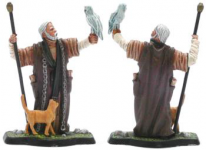
Radagast as a Mithril Miniature
-
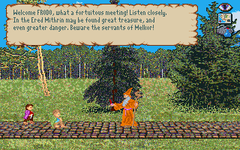
Radagast in J.R.R. Tolkien's War in Middle Earth
-

Radagast in The Lord of the Rings Trading Card Game
-
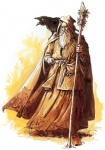
Radagast in The Lord of the Rings Strategy Battle Game
-

Radagast in The Lord of the Rings Online
-

Radagast in The Lord of the Rings: War in the North
-

Radagast in The Hobbit (film series)
-
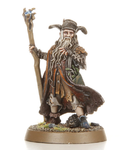
"Radagast the Brown with Sebastian" in The Hobbit Strategy Battle Game
.png)


.jpg)


Films
2001: The Lord of the Rings: The Fellowship of the Ring:
- Radagast is entirely omitted. Without Radagast's involvement, Gandalf goes to Isengard of his own accord (because he wanted counsel from Saruman) and is able to escape from the pinnacle of Orthanc by speaking to a moth who sends for the help of the Eagles.
2012: The Hobbit: An Unexpected Journey:
- Although Radagast is only briefly mentioned in The Hobbit, Radagast features in The Hobbit films and is played by Sylvester McCoy.[47] He is highly eccentric and somewhat absent-minded, and also uses a sled pulled by several large rabbits (which he refers to as 'Rhosgobel Rabbits') as his main means of transportation.
- After discovering that a shadow has fallen on Greenwood the Great (having had to heal his hedgehog friend Sebastian because of its power), Radagast enters Dol Guldur and is attacked by the Witch-king. He finds that the fortress is occupied by a Necromancer and travels to inform Gandalf. He finds Thorin and Company just west of Rivendell and hands Gandalf a morgul blade. He draws a pack of Wargs and their Orc riders away on his rabbit-pulled sled so that Thorin and Company can flee in safety.
2013: The Hobbit: The Desolation of Smaug:
- Radagast briefly appears, investigating the High Fells with Gandalf, and accompanying him to Dol Guldur. Gandalf then dispatches him to send news of what they've found to Galadriel, while Gandalf enters the fortress ruins alone.
2014: The Hobbit: The Battle of the Five Armies:
- Radagast first appears when he comes in Dol Guldur during the attack by the White Council to take the weakened Gandalf to safety. After they escape, Gandalf requests a horse, takes Radagast's staff and also commands him to summon 'bird and beast' for the impending battle. He arrives with the Eagles late in the battle along with Beorn. They demolish the Orc forces and effectively help end the Battle of Five Armies.
Radio series
1981: BBC Radio's The Lord of the Ring:
- Donald Gee provided the voice of Radagast. He is introduced much earlier than in the book because his meeting with Gandalf is given chronologically.
2001: Pán prsteňov (2001-2003 Slovak radio series):
- The voice of Radagast the Brown is provided by Vlado Černý. He appears briefly in a flashback scene, when Gandalf is recounting his meeting with Radagast, and his subsequent visit to Saruman, imprisonment and eventual escape from Orthanc.
Games
1987-: Mithril Miniatures:
- Radagast has been issued in a couple of different versions: figure LR3 "Radagast the Brown" is seen with a cat and an owl;[48] an older version of the figure portrays Radagast without beard and with a different bird.[49] There is also a "Radagast Mounted" (MS539), where Radagast (again without beard) is portrayed mounted on a horse.[50]
1988: J.R.R. Tolkien's War in Middle Earth:
- Radagast is a non-playable character in this game.
2001-: The Lord of the Rings Strategy Battle Game:
- The hero figure Radagast the Brown, is a user of subtle magics, in contrast to the more overt kinds used by Gandalf and Saruman. However, he has some unique powers nonetheless.[51]

2011-2010: The Lord of the Rings Trading Card Game:
2007-: The Lord of the Rings Online:
- In the distant past Radagast, "Master of Shapes", had taught the ancestors of the Beornings the art of skin-changing. During his stay in Rhosgobel, Radagast had come across Gollum who was stealing and eating the babies of the Woodmen and banished him from the Vales of Anduin, causing Gollum to crawl inside the caverns of the Misty Mountains. In early T.A. 3018, Radagast, on his way to see Saruman, visits Grimbeorn and bids him to send one of his children with a message for Aragorn in Bree-land.
- In the present, Radagast is first found in Ost Guruth, a small settlement of men in the Lone-lands north of the Great Road. He is friendly to the local people, the Eglain, and helps them to combat the rise of evil in the swamps of Agamaur.[53] After the War of the Ring, he tasks the player with ways of helping the living creatures around them. Radagast eventually settles back in Rhosgobel now that evil thatis departing the forest.
2011: The Lord of the Rings: War in the North:
- The characters Eradan, Farin and Andriel travel to Mirkwood in search of Radagast and arrive just in time to rescue him from the Spider Queen, Saenathra. He thanks them for the rescue and provides them with information about the Dragon Urgost.[54]
2012-: The Hobbit Strategy Battle Game:
- Radagast, based on Peter Jackson's The Hobbit, is a hero figurine in two different versions: the standard model "Radagast the Brown with Sebastian",[55] and a limited model sold with the box The Hobbit: Escape from Goblin Town.[56]
See also
External links
References
- ↑ 1.0 1.1 J.R.R. Tolkien, Carl F. Hostetter (ed.), “Part Two. Body, Mind and Spirit: V. Beards,” in The Nature of Middle-earth (HarperCollins, 2021) , footnote 1, p. 187
- ↑ 2.0 2.1 2.2 2.3 2.4 2.5 J.R.R. Tolkien, Christopher Tolkien (ed.), Unfinished Tales, "The Istari", essay on the Istari
- ↑ J.R.R. Tolkien, Christopher Tolkien (ed.), The Silmarillion, "Valaquenta: Account of the Valar and Maiar According to the Lore of the Eldar"
- ↑ 4.0 4.1 4.2 J.R.R. Tolkien, Christopher Tolkien (ed.), Unfinished Tales, "The Istari", tables relating the Istari to the Valar
- ↑ J.R.R. Tolkien, Carl F. Hostetter (ed.), “Part One. Time and Ageing: XIII. Key Dates,” in The Nature of Middle-earth (HarperCollins, 2021) , TEXT 1, p. 95
- ↑ J.R.R. Tolkien, Christopher Tolkien (ed.), Unfinished Tales, "The Istari", narrative of a council of the Valar
- ↑ J.R.R. Tolkien, Christopher Tolkien (ed.), Unfinished Tales, "The Istari", page of jottings belonging to the same period
- ↑ J.R.R. Tolkien, The Lord of the Rings, Appendix B, "The Third Age", introduction to the Tale of Years of the Third Age, p. 1085
- ↑ 9.0 9.1 9.2 J.R.R. Tolkien, The Lord of the Rings, The Fellowship of the Ring, "The Council of Elrond", p. 256
- ↑ 10.0 10.1 10.2 J.R.R. Tolkien, The Hobbit, "Queer Lodgings"
- ↑ J.R.R. Tolkien, Christopher Tolkien (ed.), The Treason of Isengard, "XV. The First Map of The Lord of the Rings", "Map II", in the middle of map square L13, p. 305
- ↑ 12.0 12.1 J.R.R. Tolkien, Christopher Tolkien (ed.), Unfinished Tales, "The Istari", note 4
- ↑ J.R.R. Tolkien, The Lord of the Rings, The Fellowship of the Ring, "The Council of Elrond", pp. 257 and 261
- ↑ J.R.R. Tolkien, The Lord of the Rings, Appendix B, "The Third Age", entry for the year 2851, p. 1088
- ↑ J.R.R. Tolkien, Christopher Tolkien (ed.), The Silmarillion, "Of the Rings of Power and the Third Age"
- ↑ 16.0 16.1 16.2 J.R.R. Tolkien, The Lord of the Rings, The Fellowship of the Ring, "The Council of Elrond", pp. 256-7
- ↑ J.R.R. Tolkien, The Lord of the Rings, Appendix B, "The Great Years", entry for the year 3018, June Mid-year's Day, p. 1091
- ↑ J.R.R. Tolkien, The Lord of the Rings, The Fellowship of the Ring, "The Council of Elrond", pp. 257-61
- ↑ J.R.R. Tolkien, The Lord of the Rings, The Fellowship of the Ring, "The Ring Goes South", p. 274
- ↑ J.R.R. Tolkien, Christopher Tolkien (ed.), The Silmarillion, "Valaquenta: Of the Valar"
- ↑ J.R.R. Tolkien, Christopher Tolkien (ed.), The Silmarillion, "Quenta Silmarillion: Of the Beginning of Days"
- ↑ J.R.R. Tolkien, Christopher Tolkien (ed.), Unfinished Tales, "The Istari", note about the Istari from 1972
- ↑ 23.0 23.1 23.2 23.3 J.R.R. Tolkien, The Lord of the Rings, The Fellowship of the Ring, "The Council of Elrond", p. 257
- ↑ 24.0 24.1 24.2 24.3 24.4 J.R.R. Tolkien, The Lord of the Rings, The Fellowship of the Ring, "The Council of Elrond", p. 258
- ↑ J.R.R. Tolkien, Christopher Tolkien (ed.), Unfinished Tales, "The Istari", essay on the Istari
- ↑ J.R.R. Tolkien, Carl F. Hostetter (ed.), “Part Two. Body, Mind and Spirit: VI. Descriptions of Characters,” in The Nature of Middle-earth (HarperCollins, 2021) , Gandalf, p. 193
- ↑ Wayne G. Hammond and Christina Scull (eds), The Lord of the Rings: A Reader's Companion, p. 245
- ↑ 28.0 28.1 28.2 J.R.R. Tolkien, John D. Rateliff (ed.), The History of The Hobbit: One-volume Edition, pp. 278, 291
- ↑ J.R.R. Tolkien; Douglas A. Anderson, (ed.), (2002) The Annotated Hobbit: Revised and Expanded Edition, p. 167
- ↑ Wayne G. Hammond and Christina Scull (eds), The Lord of the Rings: A Reader's Companion, pp. 240-241
- ↑ Tom Shippey, The Road to Middle-earth, Appendix A Tolkien's Sources: The True Tradition, 3rd edition, p. 396
- ↑ . "rudu". Bosworth-Toller Anglo-Saxon Dictionary. Retrieved 9 December 2024
- ↑ . "GÁST". Bosworth-Toller Anglo-Saxon Dictionary. Retrieved 9 December 2024
- ↑ . "Radagast". Encyclopedia of Arda. Retrieved 9 December 2024
- ↑ . "Thinking about Radagast". Lingwë - Musings of a Fish. Retrieved 9 December 2024
- ↑ J.R.R. Tolkien, Christopher Tolkien (ed.), Unfinished Tales, "The Istari", "Notes", note 6
- ↑ Wayne G. Hammond and Christina Scull (eds), The Lord of the Rings: A Reader's Companion, p. 241
- ↑ J.R.R. Tolkien, Carl F. Hostetter (ed.), “Part One. Time and Ageing: XIII. Key Dates,” in The Nature of Middle-earth (HarperCollins, 2021) , Notes, note 7, p. 102
- ↑ J.R.R. Tolkien, The Lord of the Rings, The Fellowship of the Ring, "The Shadow of the Past", p. 48
- ↑ J.R.R. Tolkien, The Lord of the Rings, The Fellowship of the Ring, "The Council of Elrond", p. 254
- ↑ J.R.R. Tolkien, John D. Rateliff (ed.), “The Second Phase: Medwed,” in The History of The Hobbit: Mr. Baggins (2007), "(vi) Radagast"
- ↑ J.R.R. Tolkien, Christopher Tolkien (ed.), The Return of the Shadow, "The Third Phase: XXII. New Uncertainties and New Projections", p. 379; J.R.R. Tolkien, Christopher Tolkien (ed.), The Return of the Shadow, "The Story Continued: XXIII. In the House of Elrond", p. 397
- ↑ 43.0 43.1 J.R.R. Tolkien, Christopher Tolkien (ed.), The Treason of Isengard, "VI. The Council of Elrond (1)", pp. 130-140
- ↑ J.R.R. Tolkien, Christopher Tolkien (ed.), The Treason of Isengard, "VI. The Council of Elrond (1)", p. 131
- ↑ J.R.R. Tolkien, Christopher Tolkien (ed.), The Treason of Isengard, "VII. The Council of Elrond (2)", p. 149
- ↑ J.R.R. Tolkien, Christopher Tolkien (ed.), The Treason of Isengard, "XI. The Story Foreseen from Moria", p. 212
- ↑ . "2 Elves and another wizard". Ian McKellen's website. Retrieved 23 December 2011
- ↑ Mithril wizards Miniatures at Mithril.ie (accessed 8 October 2011)
- ↑ Lord of the Rings (Mithril) at TwilightTangents.com (accessed 8 October 2011; cf. Radgast (image))
- ↑ 32mm Fellowship Figures - MS539 Radagast Mounted at Mithril.ie (accessed 8 October 2011)
- ↑ Radagast the Brown at Games-Workshop-com (accessed 8 October 2011)
- ↑ . "The Making of the Weta "Book Cards": Casting and Costuming". Internet Archive: Wayback Machine. Retrieved 30 June 2012
- ↑ NPC: Radagast the Brown at My.Lotro.com (accessed 8 October 2011)
- ↑ Allies at WarintheNorth.com (accessed 8 October 2011)
- ↑ "Radagast the Brown with Sebastian". Games-Workshop.com. Retrieved 30 January 2013
- ↑ "The Hobbit: Escape from Goblin Town - Limited Edition". Games-Workshop.com. Retrieved 30 January 2013
| Ainur | ||
|---|---|---|
| Valar | Lords | Manwë · Ulmo · Aulë · Oromë · Mandos · Irmo · Tulkas · |
| Valier | Varda · Yavanna · Nienna · Estë · Vairë · Vána · Nessa | |
| Maiar | Arien · Blue Wizards · Eönwë · Gandalf · Ilmarë · Melian · Ossë · Radagast · Salmar · Saruman · Tilion · Uinen | |
| Úmaiar | Sauron · Balrogs (Gothmog · Durin's Bane) · Boldogs | |
| Concepts and locations | Almaren · Aratar (indicated in italics) · Creation of the Ainur · Fana · Máhanaxar · Ainulindalë · Order of Wizards (indicated in bold) · Second Music of the Ainur · Timeless Halls · Valarin · Valinor · Valimar | |