

 | |
| Hobbit | |
| Gollum | |
|---|---|
| Biographical Information | |
| Other names | Sméagol Trahald (W) Stinker Slinker |
| Location | Vales of Anduin, Misty Mountains, Mordor, Woodland Realm, Desolation of the Morannon, North Ithilien, Shelob's Lair, Sammath Naur |
| Affiliation | Stoors, Ring-bearers |
| Language | Westron |
| Birth | c. T.A. 2430[1] Near Gladden Fields, Vales of Anduin |
| Death | 25 March T.A. 3019 (aged c. 589) Mount Doom, Plateau of Gorgoroth |
| Physical Description | |
| Gender | Male |
| Hair colour | Thin, lank[2] |
| Gallery | Images of Gollum |
And when he said 'gollum' he made a horrible swallowing noise in his throat. That is how he got his name, though he always called himself 'my precious.'

Gollum, also known as Sméagol, was a creature (originally a Stoorish Hobbit) who bore the One Ring. He lived in the Misty Mountains for most of his life. In T.A. 2941 he lost the Ring to Bilbo Baggins. For the rest of his life he sought to recover his "precious" "birthday present". In T.A. 3019 he followed the Fellowship of the Ring and met Frodo Baggins. After leading Frodo into Mordor and betraying him to Shelob he finally seized the Ring in Sammath Naur. In his euphoria he died and destroyed the Ring after falling into the fires of Mount Doom.
History
Early life
Sméagol was a Hobbit of Stoorish race who lived on the banks of the Anduin in the later Third Age, during the time of the Watchful Peace, when Sauron was in the East. He belonged to a reputable family led by a stern and wise matriarch, his grandmother.[3][4]
He had some amount of education in lore, as during his youth he learned of the events concerning the War of the Last Alliance.[5] He also knew the riddle-game, and riddles that were known to the Stoors' cousins in the Shire.[4][6]

Around the year T.A. 2463, on his birthday, his friend (and close relative) Déagol offered him a cheap present.[7] Later that day they went boating in the Gladden Fields. As Sméagol was nosing around on the banks, Déagol was pulled into the water by a large fish, and found a gold ring. Sméagol demanded the ring as a birthday present and strangled Deágol when he refused, hiding his body.[4] He thus became the fourth Ringbearer, succeeding Sauron, Isildur, and Déagol.[3]
After this incident, Sméagol returned home, telling no one of what had happened or what he had obtained. Discovering the Ring's power of invisibility, he used it for malicious purposes, spying on the other Stoors and learning their secrets. Soon he became unpopular and his peers avoided him; they often cursed and kicked him, and he bit their feet. Becoming a loner, he muttered to himself and gurgled in his throat, for which they called him "gollum", and he survived by stealing. Eventually even his grandmother, desiring peace, cast him out of the family hobbit-hole.[4]
Exile

Following his exile, Sméagol wandered up the Anduin and followed a stream to some deep pools. He lived on fish, which he ate raw. After some time, the sun began to burn his skin and eyes, leading him to seek shelter in the caves from which the stream issued, high in the Misty Mountains.[4]
The Ring's malignant influence twisted his Hobbit body and mind and prolonged his life far beyond its natural limit. The murder of Déagol haunted him, and he reassured himself by imagining that the Ring had been given to him by his grandmother as a birthday present. He began talking to the Ring constantly, calling it his "precious".[4]

For over four hundred years he lived on a small island surrounded by a subterranean lake. He lived mostly on raw fish that he caught from his raft, though he sometimes managed to lay his hands on Goblins that had strayed from Goblin-town. In later years he began to find Hobbit and Elven food repulsive. The Ring's corrupting influence as well as centuries of isolation in the Misty Mountains took a deep toll on him both physically and mentally. He became disfigured and grotesque in appearance, and by the time he met the Hobbit Bilbo Baggins he was afflicted with almost complete madness.
Loss of the Ring
In T.A. 2941, during the Quest of Erebor, Bilbo stumbled upon the Ring in the network of caves leading to Gollum's lake, Gollum having dropped it while hunting Goblins. It is possible that the Ring had a part in this, for it was known to have a will of its own. As Gandalf said later, the Necromancer was becoming more powerful, and it was a good time for the Ring to change hands and get back to Sauron.[4]

While still unaware of his loss, Gollum met Bilbo and engaged in the famous riddle-game. Gandalf later remarked that a small part of Gollum was glad to see another Hobbit for the first time in many years, but that this only made the evil part of him angrier.[4] Following the game, Gollum refused to show Bilbo the promised way out and instead plotted to kill him. Before he could carry this out, he realized his "precious" was gone. Enraged, he gave Bilbo chase. The latter inadvertently stumbled upon the Ring's power of invisibility as he ran, allowing him to follow Gollum to the cave exit. There, Bilbo thought to kill Gollum, but pity struck him, so he instead jumped over him and fled.[8]
Into the wild
Gollum spent a further three years skulking in the mountains,[3] but his longing for the Ring eventually overcame his hatred of sunlight, and so he sallied forth in search of Bilbo. Travelling by night, he passed through Mirkwood and reached Lake-town and Dale. He spent his time there spying and eavesdropping, which allowed him to learn more of Bilbo. He then headed in the direction of the Shire, but before he could cross the Great River, he suddenly turned southwards. Gandalf had been tracking him all the while with the help of the Elves of Mirkwood, but he gave up the chase at this time, something he would later regret.[4]
Sauron began to summon all evil creatures to Mordor, hoping to build up his strength in the coming years. Because the One Ring had left a permanent mark on him after bearing it for so long, Gollum felt compelled to answer that summons and make his way to Mordor. After some thirty years of wandering he reached the Mountains of Shadow, and met Shelob.[3] Upon venturing into Mordor itself, he was captured and tortured by Sauron, who thereby learned that the Ring had been recovered and was in the possession of a Shire Hobbit. Meanwhile, Gandalf had begun to suspect that Bilbo's ring was the One Ring, which led him to resume his search for Gollum..jpg)
War of the Ring
In T.A. 3018, Orcs raided the Elves of Mirkwood, allowing Gollum to escape. He entered Moria, but was unable to open the Doors of Durin. Some months later, the Fellowship of the Ring passed through Moria, and Gollum began trailing it. When the Fellowship broke at Nen Hithoel, Gollum followed Frodo and Sam into the Emyn Muil. After a confrontation in which he bit and nearly strangled Sam, Frodo subdued him. Frodo tied an Elvish rope around Gollum's ankle for a leash, but the mere touch of the rope pained him. Taking pity on the wretched creature, Frodo made Gollum swear to help them. Gollum swore by the "precious" itself to do so, and Frodo released him. The unlikely company, guided by Gollum, made its way to the Black Gate, the entrance to Mordor.
Frodo's kindness brought out what remained of Gollum's better side, and he made at least some effort to keep his promise. The two had a strange sort of bond from having both been Ringbearers; in Gollum, Frodo saw his possible future, and so wanted to save him so he could save himself. Gollum feared Frodo, and also thought that helping him would deprive Sauron of the Ring.
When the Black Gate was reached and found to be well-guarded, Gollum convinced Frodo and Sam to follow him south, where he knew of another entrance into Mordor. Before they could reach it, Frodo and Sam were captured by Faramir. Gollum followed the captives to the secret outpost of Henneth Annûn, where he was spotted. Faramir then forced Frodo to aid Faramir's men in capturing the creature, a betrayal that Gollum felt keenly. While questioning Gollum, Faramir learned that the place to which he had been leading the Hobbits was Cirith Ungol. He warned Frodo and Sam that this was a place of great evil and that their guide was not to be trusted.

Upon regaining their freedom, Frodo, Sam, and Gollum set out again for Mordor and reached the pass of Cirith Ungol. One night, Gollum visited the great spider Shelob, because he was planning to betray the Hobbits to her and then get the Ring for himself. When he returned the Hobbits were asleep. The sight of Frodo sleeping nearly moved Gollum to repent.[9] However, Sam woke up and spoke harshly to Gollum, and all hope of redemption was lost. Gollum followed through with his plan and led Frodo and Sam into Shelob's Lair. For this service to Shelob, the Orcs of Cirith Ungol referred to him as "her sneak".
Just as Frodo warned him, Gollum's breach of his oath ultimately led to his undoing, for Frodo and Sam escaped from Shelob's lair and came against all odds to the volcano Mount Doom. Gollum followed them all the way, seeking a chance to surprise them and take the Ring. When Frodo and Sam had almost reached their destination, he attacked, but failed to get the Ring. Sam, who had hated Gollum on sight, tried to bring himself to kill him, but relented out of sheer pity and disgust, turning his back on the beaten creature.
Moments later, Frodo fell victim to the Ring's power and put it on his finger instead of casting it into the Cracks of Doom as he had meant to. Then Gollum attacked again. The two fought while Frodo was invisible and finally Gollum bit off Frodo's finger.
Here Frodo's kindness in sparing Gollum's life was rewarded, for Gollum then teetered on the edge of the great pit, lost his balance and fell in, taking the Ring and finger with him with a last cry of "Preciouss!". Had Gollum not lived to play this final part, there would have been a good chance that Sauron would have regained the Ring, as he knew where Frodo was as soon as he put the Ring on.
Characteristics
Appearance

Sméagol was a Hobbit, but he spent long centuries in darkness and damp, influenced by the power of the Ring. It is possible that thanks to his hardy Hobbitish nature that he was not reduced to a wraith.[10] However, he was reduced to a small, extremely thin and wiry person, with scrawny neck, pale skin, flat feet, long thin hands with clammy fingers, and large pale or green eyes that seemed to glow. His sense of sight, as well as his hearing and smelling, was very good, due to the time he spent underground.
He could move and climb silently like a spider, and although he had only six teeth left,[11] he could give deep bites, even able to bite off Frodo's finger.
Personality
Sméagol was quick and strong, the most inquisitive and curious-minded of his community. He was interested in roots and beginnings. He owed his name to his interest in roots and deep pools; he dove, burrowed and tunnelled under trees, plants, and mounds. He tended to neglect anything that was higher, like the flowers, the trees and looking at the hills.[4]
During his centuries of loneliness and under the Ring's influence, he seems to have developed something similar to a personality disorder: his "Gollum" personality was a slave to the Ring and would kill for it, overwhelming his former self, who still vaguely remembered things like friendship and love. Not having anyone else to speak to, he often quarreled with himself. Gollum both loved and hated the Ring and himself. He often referred both to the Ring and himself as "my Precious", perhaps confusing the two entities.[1]

Years later, Samwise Gamgee would give two nicknames to Gollum. Originally, Sam used the name Slinker to refer to Gollum's slinking around before they had captured him.[12] He then came to use Slinker and Stinker to refer to the two contrasting sides of Gollum's personality,[13] caused by possession of the One Ring for so long.[14] Slinker was the fawning, desperate, and eager-to-please, "Sméagol" side demeanour; and Stinker was the plotting and sinister "Gollum" side of him.[13] When he first came into the service of Frodo Baggins his Slinker side was more prominent but the closer they got to the Black Gate the more the Stinker side started to take over and Slinker became more like Stinker and Sam started using the name to generally refer to Gollum.[15]
Other aspects of the Ring's corruption was the aversion to all living creatures, especially the Elves and all things Elven. The Elven rope burnt his skin, and lembas tasted like dust to him and choked him.
Sméagol, as a Hobbit, was perhaps good at heart, but he was relatively greedy and mean.[7] Bilbo was corrupted far more slowly by the Ring because his adventures with it began with an act of mercy, while Gollum began his with murder.[4]
Etymology
| The Old English pronunciation of Sméagol | |
 |
File:Anglo-Saxon - Sméagol.mp3 |
| By Gilgamesh. (Media help) | |
Although Sméagol's people spoke Westron natively, J.R.R. Tolkien notes that he and his kinsman Déagol bore names taken from "the Mannish language of the region near the Gladden", which was related to Rohanese.[16] His actual name was Trahald, meaning "burrowing" or "worming in". As Rohanese is represented in the books by Old English, this was translated as Sméagol.[17] Peter Gilliver, Edmund Weiner and Jeremy Marshall derive Sméagol from the Old English verb sméagan, meaning "to scrutinize, investigate", and the adjectival suffix -ol,[18] while Wayne G. Hammond and Christina Scull derive it from smygel, meaning "burrow, place to creep into".[19][20]
The Old English pronunciation would be [ˈsmæɑːɣol]; however, Tolkien himself used the modernized pronunciation /ˈsmiːgɔːl/.[21]
Other versions of the legendarium
In the first edition of The Hobbit, Gollum did not appear quite as wretched or as bound to the Ring. Tolkien revised this characterisation to fit the concept of the Ruling Ring developed during the writing of The Lord of the Rings. Tolkien then explained the version given in the first edition as a lie that Bilbo made up to tell the Dwarves and Gandalf.[22]
In The Silmarillion, it is mentioned that the One Ring was found "ere the Kings failed in Gondor". This can mean that originally, Gollum's age was intended to be considerably more than six hundred years (further reinforced by certain places in The Lord of the Rings like Gollum referring to tales about an uncorrupted Minas Ithil or Gandalf comparing his people to "fathers of the fathers of the Stoors"). In fact it seems likely that Sauron leaving the Mirkwood in 2063 T.A. and some Hobbits settling there after that are details added for the purpose of making the smaller age possible; perhaps in order to make it possible for Gollum and the other characters to have the same language.
Inspiration
John Garth has suggested that the character of Gollum carries echoes of the "night-haunting, man-eating" ogre Grendel in Beowulf.[23]
Portrayal in adaptations
-

-

-

-

-

-

-

-

As Sméagol in The Lord of the Rings (film series)
-

-

-
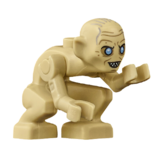
-

-

-

_-_Gollum.jpg)
_-_Gollum.jpg)
_-_Gollum.jpg)

_Gollum.JPG)


_-_Gollum.JPG)


Films
1977: The Hobbit (1977 film):
- Gollum is a frog-like green creature, voiced by Brother Theodore. Here, his "Gollum" noise sounds like muttering instead of swallowing.
1978: The Lord of the Rings (1978 film):
- Gollum is depicted as a skinny, dark grey creature, voiced by Peter Woodthorpe.
1980: The Return of the King (1980 film):
- Brother Theodore reprised his role from the earlier Rankin/Bass production. Some footage from The Hobbit was reused to introduce the viewer to the story.
2001-03: The Lord of the Rings (film series):
- Gollum is a CGI-motion capture creature voiced by actor Andy Serkis. He is barely glimpsed in The Fellowship of the Ring, where he is voiced by Dominic Monaghan in absence of Serkis.[source?] Gollum becomes a central character in The Two Towers and The Return of the King. The ground-breaking CGI character was built around Serkis's voice, movements and expressions, sometimes by using a motion capture suit which recorded his movements and applied them to the digital character, and sometimes by the more laborious process of digitally "painting out" Serkis's image and replacing it with Gollum's. In one such shot in The Two Towers, Serkis' real spittle can be seen emerging from Gollum's mouth.
- In The Return of the King Serkis himself appears in a flashback scene as Sméagol before his degeneration into Gollum. This scene was originally earmarked for The Two Towers but held back because it was felt that audiences would relate better to the original Sméagol once they were more familiar with who he became. The decision to include this scene meant that Gollum's face had to be redesigned for the second and third movies so that it would more closely resemble Serkis'.
2012: The Hobbit: An Unexpected Journey:
- Andy Serkis reprised his role as Gollum.[24]
Television
1993: Hobitit:
- Gollum is depicted as an old, white creature, portrayed by Kari Väänänen, the same actor who played Aragorn in the series.
Radio series
1955: The Lord of the Rings (1955 radio series):
- The voice of Gollum is provided by Gerik Schjelderup.[25]
1968: The Hobbit (1968 radio series):
- The narrator refers to Gollum (voiced by Wolfe Morris) as "Galloom", even though Gollum himself manages to pronounce his name correctly. Gollum's role is based on that of the second edition of The Hobbit.[26]
1979: The Lord of the Rings (1979 radio series):
- Gail Chugg provided the voice of Gollum.
1980: Der Hobbit (1980 German radio series):
- Gollum is played by Jürgen von Manger.
1981: The Lord of the Rings (1981 radio series):
- Gollum, again performed by Peter Woodthorpe, has the first lines of the play (save the narrator). He is described as "slimy and as dark than darkness".[27]
1989: Hobit (1989 Slovak radio series):
- The voice of Gollum is provided by Karol Čálik.
1992: Der Herr der Ringe (1992 German radio series):
- Gollum is played by Dietmar Mues.
2002-2003: Pán prsteňov (2001-2003 Slovak radio series):
- The voice of Gollum is provided by Ibrahim Maiga.
Games
1982: The Hobbit (1982 video game)
- Gollum appears in the tunnels of the Misty Mountains. He will persistently speak riddles to Bilbo, and strangle him to death if he fails to answer them in time. However, if Bilbo puts the Ring on, then Gollum will not be able to see him. He can also be killed by Bilbo or his companions, even though doing so would seriously conflict with established canon.
2002: The Lord of the Rings: The Fellowship of the Ring (video game):
- Gollum, voiced by Quinton Flynn, is seen thrice: first, in the introduction scene, he is stooping over his precious, dashing away from the camera. He is a creature in colour and clothing much like Jackson's version. He is briefly glimpsed again in Moria, but not more than a dark shape with a green outline can be seen.[28] His most important role is in the final stages of the game: he can be seen atop several ridges, and can even be visited on a rock on the shores of Nen Hithoel. He throws a fish, the "Xiphiidae", at "Ranger". This will become the most deadly weapon in the game, and replaces Andúril in the weapon slots.[29]
2003: The Lord of the Rings: The Return of the King (video game):
- Gollum is accompanying Sam and Frodo during Osgiliath mission and the is the final boss of the game at the Crack of Doom. Unlike all other enemies of the game, he takes no damage from any attacks - instead the players must perform combinations to push him into lava below.
2003: Sierra's The Hobbit:
- Gollum appears in a cut scene after the level "Riddles in the Dark". Only Bilbo's last riddle - "What have I got in my pocket?" - is shown, after which Gollum spouts out all possible answers in one sentence rather than in three turns. Gollum is a dark grey, hobbit-like creature with seven spiky teeth, who walks on all fours like an ape would, and like his Rankin/Bass counterpart, his "Gollum" noise is a muttering instead of a swallowing. He is voiced by Daran Norris.[30]
2004: The Lord of the Rings: War of the Ring:
- Gollum is a "Hero" unit for the Servants of the Enemy, used primarily for scout missions.
2004: The Lord of the Rings: The Battle for Middle-earth:
- Gollum is a "Hero" for the Mordor factions. His health is extremely low and his attacks extremely weak, but has value for the scout missions.
2006: The Lord of the Rings: The Battle for Middle-earth II:
- In non-storyline battles, stealthed Gollum is roaming the map. If detected and killed, he drops The One Ring, which can give huge advantage to the side that gets it.
2007: The Lord of the Rings Online:
- Gollum is encountered thrice, though the player has yet to know his name. The first time he is met in southern Trollshaws, where the player prevents him from attacking the baby of two Fishermen; the second time he is seen in southern Mirkwood, where the player must defeat the Orcs who attempts to capture him, the third time is on the Shores of Anduin, where the player has to make sure he does not fall prey to the spiders.
2012: Guardians of Middle-earth:
- Gollum is a striker-type "guardian" with four abilities: Throttle, My Precious, Coward and We are starved.[31]
2014: Middle-earth: Shadow of Mordor:
- Gollum is featured in the game as a supporting character. In the game, set between The Hobbit and The Lord of the Rings, Gollum is searching for the One Ring and encounters Talion, the protagonist of the game and helps him in his Quest.
2017: Middle-earth: Shadow of War:
- Gollum is featured in the game as a supporting character.
2023: The Lord of the Rings: Gollum:
- Gollum appears in the game as the protagonist character.
External links
References
- ↑ 1.0 1.1 Robert Foster, The Complete Guide to Middle-earth, p. 167, entry "Gollum"
- ↑ J.R.R. Tolkien, The Lord of the Rings, The Two Towers, "The Taming of Sméagol"
- ↑ 3.0 3.1 3.2 3.3 3.4 J.R.R. Tolkien, The Lord of the Rings, Appendix B, "The Third Age"
- ↑ 4.00 4.01 4.02 4.03 4.04 4.05 4.06 4.07 4.08 4.09 4.10 J.R.R. Tolkien, The Lord of the Rings, The Fellowship of the Ring, "The Shadow of the Past"
- ↑ J.R.R. Tolkien, The Lord of the Rings, The Two Towers, "The Passage of the Marshes"
- ↑ J.R.R. Tolkien, The Hobbit, "Riddles in the Dark"
- ↑ 7.0 7.1 J.R.R. Tolkien; Humphrey Carpenter, Christopher Tolkien (eds.), The Letters of J.R.R. Tolkien, Letter 214, (undated, written late 1958 or early 1959)
- ↑
- ↑ J.R.R. Tolkien, The Lord of the Rings, Appendix B, "The Great Years"
- ↑ . "Why hadn’t Gollum turned into a wraith long ago?". FAQ of the Rings
- ↑ J.R.R. Tolkien, The Hobbit, "Riddles in the Dark"
- ↑ J.R.R. Tolkien, The Lord of the Rings, The Two Towers, "The Taming of Sméagol", p. 604
- ↑ 13.0 13.1 J.R.R. Tolkien, The Lord of the Rings, The Two Towers, "The Black Gate is Closed", p. 638
- ↑ J.R.R. Tolkien, The Lord of the Rings, The Fellowship of the Ring, "The Shadow of the Past", pp. 53-5
- ↑ J.R.R. Tolkien, The Lord of the Rings, The Two Towers, "The Stairs of Cirith Ungol", p. 714
- ↑ J.R.R. Tolkien, The Lord of the Rings, Appendix F, "The Languages and Peoples of the Third Age", "Of Hobbits", footnote after "before they came north the the Shire.", p. 1130
- ↑ J.R.R. Tolkien, The Lord of the Rings, Appendix F, "On Translation", p. 1136
- ↑ Peter Gilliver, Edmund Weiner and Jeremy Marshall, The Ring of Words: Tolkien and the Oxford English Dictionary, p. 191
- ↑ "smygel". Bosworth-Toller Anglo-Saxon Dictionary. Retrieved 13 January 2026
- ↑ Wayne G. Hammond and Christina Scull (eds), The Lord of the Rings: A Reader's Companion, p. 86
- ↑ "Tolkien reads - Of herbs and stewed rabbit". YouTube. Retrieved 13 January 2026
- ↑ Bonniejean Christensen, Jared Lobdell (ed.), "Gollum's Character Transformation in The Hobbit", published in A Tolkien Compass, pages 7-26
- ↑ . "J R R Tolkien's Beowulf: one man's passion for the threshold between myth and reality". newstatesman.com. Retrieved 29 May 2014
- ↑ . "Production begins in New Zealand on The Hobbit". Facebook. Retrieved 21 December 2011
- ↑ Radio Times, Volume 133, No. 1723, November 16, 1956
- ↑ The Hobbit (1968 radio series), "Riddles in the Dark"
- ↑ The Lord of the Rings (1981 radio series), "The Long Awaited Party"
- ↑ The Lord of the Rings: The Fellowship of the Ring (video game), "3 Passages"
- ↑ The Lord of the Rings: The Fellowship of the Ring (video game), "Amon Hen"
- ↑ The Hobbit (2003 video game), "Riddles in the Dark"
- ↑ "Guardians of Middle-earth: Gollum". Guardians of Middle-earth official website. Retrieved 16 July 2012
Born | Gollum | Died |
Preceded by | Followed by | |
Preceded by | None Ring destroyed |
| Ring-bearers of the One Ring | |
|---|---|
| Sauron (S.A. 1600 - 3441) · Isildur (S.A. 3441 - 25 September, T.A. 2) · Déagol (c. 2463) · Sméagol (c. 2463 - 2941) · Bilbo Baggins (2941 - 22 September, 3001) · Frodo Baggins (22 September, 3001 - 13 March, 3019) · Samwise Gamgee (13 March, 3019 - 14 March, 3019) · Frodo Baggins (14 March, 3019 - 25 March, 3019) · Gollum (25 March, T.A. 3019) | |
| Also briefly held the Ring: Gandalf (13 April, T.A. 3018) · Tom Bombadil (27 September, T.A. 3018) | |